
The Problem Most CFD Brokers Are Not Measuring
You invest in brand building. You run compliant Google Ads campaigns. You publish educational content and earn regulator trust. Then a user searches your brand name on Google and clicks a “Top 10 CFD Brokers” list before they ever see your website. That list may rank you favorably. It may not. Either way, a third party just inserted itself between your brand investment and your conversion. That is SERP leakage, and for most CFD brokers, it is one of the most expensive problems in the acquisition funnel.
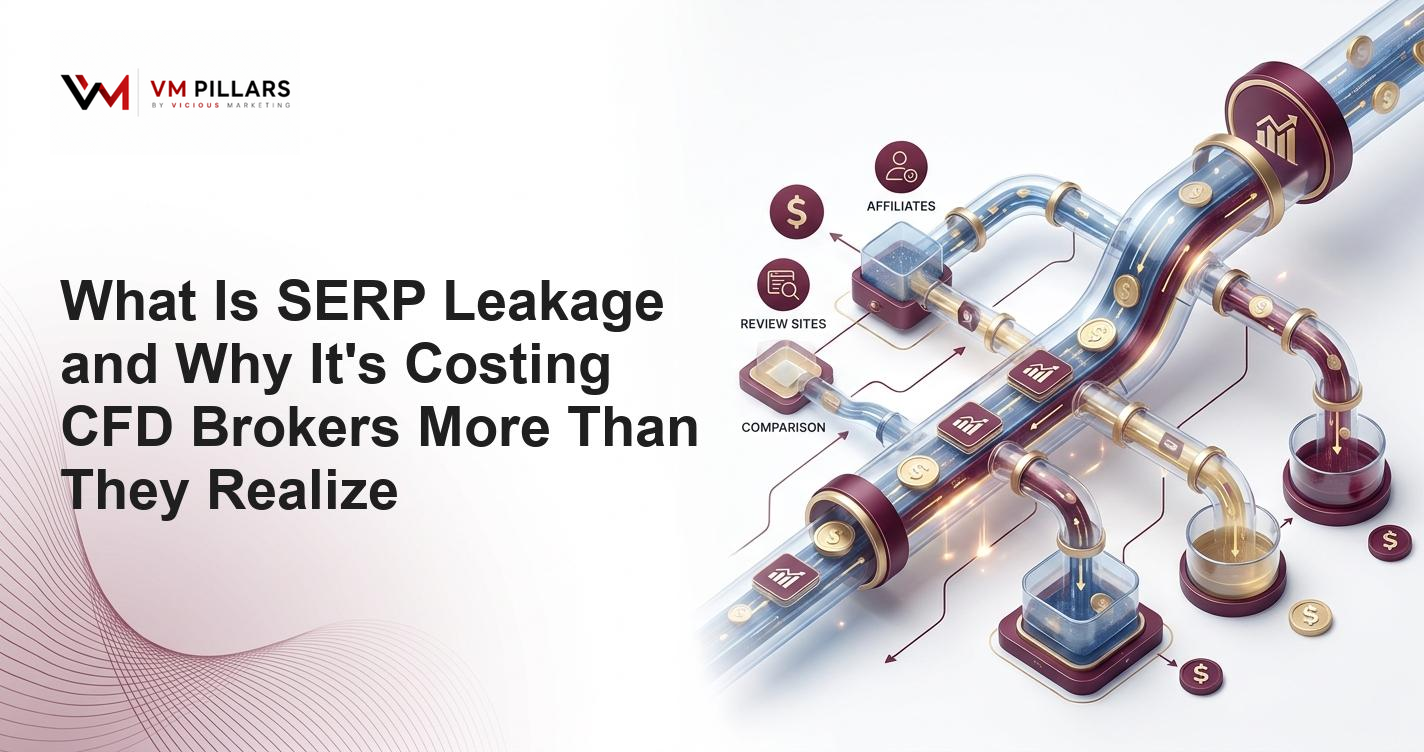
SERP leakage occurs when affiliates, review sites, comparison platforms, or even competitors rank above or alongside your brand in search results, intercepting users who had clear intent to find you. The conventional framing treats this as an SEO ranking problem. That framing is incomplete. SERP leakage is a revenue control problem. Every intercepted click is a unit of acquisition cost you already paid for, now being redirected through a third-party layer that charges you again on the back end via affiliate commissions or cost-per-acquisition deals.
Most brokers discover this problem accidentally, if they discover it at all. Standard analytics dashboards show you traffic volumes, conversion rates, and cost per click. They do not show you how many users arrived at your site only after passing through an affiliate page first, nor do they show you how many never arrived at all because a comparison platform made the decision for them.
How SERP Leakage Actually Works in CFD Markets
To understand the financial impact, you need to understand the mechanics. When a prospective trader searches a high-intent query, whether that is your brand name, a product query like “spread betting platform UK,” or a research query like “best CFD broker for indices,” Google serves a results page. That page has limited real estate. According to Backlinko’s analysis of four million search results, the top organic position captures an average click-through rate of 27.6%, while positions two and three receive 15.8% and 11.0% respectively. Traffic loss compounds quickly as positions drop, meaning that a single SERP position lost to an affiliate site is not a marginal inconvenience. It is a structural, recurring transfer of qualified attention.
In CFD markets specifically, the affiliate ecosystem is aggressive and well-funded. Review sites, broker comparison platforms, and “Top Broker” list publishers invest heavily in SEO precisely because the CPC economics make it worthwhile. Financial keywords in English-speaking markets carry average CPCs ranging from $30 to over $100 per click, according to WordStream industry benchmarks. When a comparison site ranks organically for a query you are bidding on in paid search, they are capturing traffic at zero marginal cost while you absorb the full click cost. The economics of that dynamic compound at scale.
The problem intensifies on branded queries. A user searching your exact brand name has already made a directional decision. They are not comparing options. They are looking for you. When an affiliate ranks above your homepage for your own brand term, they intercept a user who was already yours. According to Investment Trends’ Global CFD Report, affiliates and comparison sites account for an estimated 20 to 40 percent of new broker account registrations in tier-1 markets such as the UK, Australia, and Germany. A meaningful portion of that volume originates from users who searched a brand or product term directly, were intercepted by a third party, and then converted through an affiliate link. You acquired the customer, but paid twice.
The Three SERP Leakage Scenarios CFD Brokers Face
Not all SERP leakage carries the same cost or requires the same response. Understanding the three primary scenarios helps you prioritize where to act first and how aggressively to respond.
Scenario 1: Branded Query Interception
This is the highest-cost leakage type. A user searches your brand name and encounters a third-party site before reaching your homepage. The third party may recommend you, list you alongside competitors, or actively position an alternative. Even when the affiliate recommends you favorably, you are paying an acquisition commission on a user who already intended to sign up with you. The affiliate added no discovery value. They added only friction and cost. Your immediate action here is to audit your brand keyword SERP weekly, own every paid and organic position available on your brand terms, and investigate the affiliate agreement structure for any partners ranking on your branded queries.
Scenario 2: High-Intent Product Query Interception
A user searches “best CFD broker for commodities” or “low spread forex broker UK.” These queries signal strong purchase intent. Comparison sites and review platforms dominate these SERPs in most regulated markets because their content structure, link authority, and publishing volume are purpose-built for these rankings. You are unlikely to outrank every aggregator on every competitive product query in the short term. Your response here is not to chase every ranking but to identify which product queries carry the highest conversion value for your specific offering, then build targeted content and link authority around that narrower set.
Scenario 3: Reputation and Research Query Interception
A user searches “Is [Your Brand] legit?” or “[Your Brand] review.” These are verification queries. The user is at a critical decision point and seeking third-party validation. If an unfavorable review or an outdated comparison article owns this SERP position, the conversion you spent $200 to $500 acquiring is now at risk. Your response here is to publish your own structured review and trust content, claim and optimize your profiles on major review platforms, and monitor these queries with the same urgency you apply to performance metrics.
The Hidden Financial Architecture of SERP Leakage
Here is where conventional thinking fails most CFD marketing teams. SERP leakage is typically flagged as an SEO issue and handed to a content team with a brief to “rank better.” That diagnosis misses the actual cost structure. The real damage operates across three financial layers simultaneously, and none of them appear cleanly in a standard analytics report.
Layer 1: Direct acquisition cost inflation. Every customer who converts through an affiliate link after being intercepted on a high-intent query represents a margin reduction. You are paying an acquisition fee on traffic that your brand investment generated. If your affiliate payout is $300 per funded account and your organic CAC would have been $80 for that same user, the leakage cost is $220 per account, invisible in your CAC dashboard because the affiliate channel shows as a separate line item.
Layer 2: Compounding paid media inefficiency. When affiliates rank organically for queries you are bidding on in paid search, your paid inventory is competing against free organic captures. Your quality scores and ad auction dynamics shift. In some cases, you are bidding against the affiliate’s own paid campaigns for the same user at the same moment. This inflates your CPCs and reduces campaign efficiency across the entire account, not just on the intercepted queries.
Layer 3: Funnel attribution distortion. Boston Consulting Group’s analysis of digital revenue in financial services found that companies lose up to 30 percent of digital revenue to inefficiencies in online customer acquisition funnels, including untracked referral paths and intermediary capture. When a user touches an affiliate page between their initial search and your conversion event, that interaction is frequently untracked or misattributed. Your analytics show the affiliate as the source. The original organic brand search that triggered the journey disappears from the data. You make budget allocation decisions based on a distorted view of what actually drove the conversion.
| Leakage Type | Query Example | Primary Cost Driver | Measurement Challenge | Priority Level |
|---|---|---|---|---|
| Branded interception | “[Brand Name] trading platform” | Affiliate commission on owned intent | Attribution path breaks at affiliate touchpoint | Critical |
| High-intent product query | “Best CFD broker UK 2025” | Inflated paid CPC, lost organic traffic | Organic vs. affiliate source conflation | High |
| Reputation and review query | “Is [Brand] a legitimate broker?” | Conversion drop-off at decision stage | Invisible in funnel analytics | High |
| Competitor comparison query | “[Brand] vs [Competitor]” | Lost conversion to competitor via comparison page | Exit point untracked | Medium |
A Practical Framework for Diagnosing Your SERP Leakage Exposure
Before you can fix SERP leakage, you need an accurate picture of where it is occurring and at what scale. This is not a one-time audit. It is an ongoing SERP ownership discipline. The following framework gives you a structured starting point that you can apply immediately.
- Build your priority query list. Start with three categories: your brand terms and common brand variations, your highest-converting product queries from paid search, and your top organic landing page queries. These represent the queries where leakage carries the highest financial consequence. Limit your initial audit to 30 to 50 queries so the process is manageable and focused on real exposure rather than theoretical coverage.
- Run incognito SERP checks from your target geographies. Google personalizes results, so standard browser searches distort what your actual users see. Use incognito mode or a geo-specific browser extension to check SERPs from your primary regulated markets, whether that is the UK, Australia, Germany, or another tier-1 jurisdiction. Record every third-party site appearing in positions one through five on each priority query.
- Classify each intercepting site by type and relationship. Categorize each third-party result as an affiliate partner, an unaffiliated review site, a direct competitor, a regulatory or news source, or a comparison aggregator. Your response strategy differs significantly by type. An affiliate partner you have a commercial agreement with requires a different conversation than an unaffiliated review site publishing inaccurate information.
- Cross-reference against your affiliate program payouts. Pull your affiliate partner list and check which registered affiliates are ranking on your branded or high-intent queries. Calculate the estimated commission volume attributable to traffic they are intercepting rather than generating. This single step frequently reveals the most significant and immediately actionable cost savings.
- Assign a revenue impact estimate to each leakage point. Use your average funded account value, affiliate commission rate, and estimated monthly query volume to build a rough financial model for each leakage scenario. Even conservative estimates usually reveal that SERP leakage represents a six-figure annual cost for mid-size CFD brokers operating in competitive markets.
- Establish a monthly monitoring cadence. SERP positions shift constantly, especially in financial services where affiliates actively compete for rankings. A quarterly review is not sufficient. Set a monthly SERP audit as a standard operational process, tracked in the same dashboard where you monitor paid media performance and organic traffic.
What Zero-Click Search Means for Your SERP Leakage Exposure
The SERP leakage problem is compounding because the available inventory of organic clicks is shrinking. SparkToro’s research, led by Rand Fishkin, found that approximately 58.5 percent of all Google searches in the US result in zero clicks, driven by featured snippets, knowledge panels, and AI-generated answer summaries. When more than half of all searches never produce a click, the clicks that do happen carry greater individual value. Every high-intent click your users generate represents scarcer, more valuable acquisition opportunity than it did three years ago.
This changes the economics of SERP leakage materially. When organic click volume was higher, losing a percentage of branded traffic to affiliates was a controllable inefficiency. In today’s search environment, where AI overviews and zero-click results reduce the total click pool, each affiliate interception represents a larger share of a smaller total. CFD brokers operating under this assumption need to treat SERP ownership as a core acquisition priority, not a peripheral SEO concern handled by a junior content team.
The implication for your strategy is direct. You cannot grow your way out of SERP leakage by simply increasing paid budgets. If zero-click results are reducing organic click inventory and affiliates are capturing a growing share of what remains, scaling spend without addressing SERP ownership simply inflates costs without improving the underlying yield. The math does not work in your favor. Fix the leakage first, then scale the spend.
How to Respond to SERP Leakage Without Burning Your Affiliate Relationships
One of the most common objections to addressing SERP leakage is the risk of damaging affiliate relationships that contribute genuine top-of-funnel discovery value. This concern is legitimate but often overstated. The goal is not to eliminate affiliates from your marketing ecosystem. It is to ensure that affiliates are generating new demand, not intercepting demand you already created through your own brand investment.
Start by revising your affiliate program terms to explicitly restrict bidding on your brand terms in paid search and organic ranking on branded queries. Most affiliate agreements allow this restriction, and enforcing it is a standard practice among mature broker programs. Pair that restriction with clear commercial logic for your partners: if you protect brand traffic from interception, you can offer higher CPAs for genuinely new user acquisitions because your blended CAC improves. This creates a commercially aligned incentive rather than an adversarial restriction.
For unaffiliated review sites and aggregators that you have no commercial relationship with, your response is an organic content and authority-building strategy targeted specifically at the queries they dominate. Publish your own detailed review content, optimize your brand profile pages on major aggregators where you do not control the ranking, and build internal links to the pages that compete directly with the intercepting third-party content. This is a medium-term play, but it directly reduces leakage on the queries where you have no commercial lever to pull.
Specialist agencies that work specifically in CFD and regulated financial services understand this dual requirement, which is why Vicious Marketing frames SERP leakage as a revenue control issue rather than a traditional SEO problem. The distinction matters because it changes who owns the problem inside your organization and what budget authority is attached to solving it.
Common Mistakes CFD Brokers Make When Addressing SERP Leakage
Understanding the problem is only half the equation. Avoiding the most frequent execution errors determines whether your response actually reduces costs or simply creates new ones.
- Treating SERP leakage as a one-time audit task. A single audit gives you a snapshot. The SERP is a dynamic, constantly shifting competitive environment. Affiliates update their content, gain and lose links, and shift their targeting regularly. Without a recurring monitoring process, your leakage map becomes outdated within weeks.
- Focusing exclusively on organic rankings while ignoring paid coverage. If an affiliate is ranking organically above your homepage for your brand term, adding a paid brand campaign is a valid short-term defense. Owning the top paid position above the organic affiliate result restores your SERP visibility while your organic authority catches up. Many brokers leave this gap open because paid brand campaigns feel redundant. They are not when leakage is active.
- Misidentifying the source of the leakage problem. Some brokers attribute SERP leakage primarily to weak content or poor domain authority. In many cases, the actual driver is an affiliate program structure that inadvertently incentivizes brand-term targeting. Fixing content without reviewing affiliate program terms and enforcement leaves the core incentive structure intact.
- Measuring success by rankings instead of revenue outcomes. SERP leakage analysis should be tied to funded account acquisition costs, affiliate commission savings, and direct conversion rate changes. If your branded query positions improve but your affiliate commission expense as a percentage of total CAC does not change, you have not solved the problem. Measure what matters.
- Ignoring mobile and regional SERP variance. Mobile SERPs frequently differ from desktop results, and geo-specific results differ significantly across regulated markets. An audit conducted only on desktop from a single location will miss leakage occurring on mobile or in other target geographies. CFD brokers operating across multiple regulated jurisdictions need SERP monitoring configured for each primary market.
Bottom Line
SERP leakage is not an SEO problem. It is a revenue control problem, and in CFD markets, it operates at a scale most brokers have never measured accurately. When affiliates intercept users on branded queries, they are taxing your brand investment. When comparison sites dominate high-intent product queries, they are extracting margin from your acquisition funnel at the exact moment a prospective trader is ready to convert. When zero-click search continues to shrink the total organic click pool, every intercepted click represents a larger share of your available acquisition opportunity.
The brokers who treat SERP ownership as a core performance discipline, auditing it regularly, tying it to funded account economics, and aligning affiliate program incentives accordingly, are the ones who compress their CAC over time rather than watch it inflate. The brokers who treat it as a background SEO concern are subsidizing their competitors and their affiliates simultaneously, often without knowing it.
We have seen this pattern consistently across regulated markets. The cost is real, it is measurable, and fixing it does not require a dramatic overhaul of your marketing strategy. It requires clarity about where your SERP real estate is being captured, by whom, and at what financial cost. Start there.
Frequently Asked Questions
Q1: What specific tools can CFD brokers use to monitor SERP leakage effectively?
A: Specialized SERP tracking tools like Semrush, Ahrefs, or STAT can monitor keyword rankings across different geographies and device types. Advanced attribution platforms and custom analytics configurations can help connect intercepted journeys to affiliate payouts and true acquisition costs.
Q2: How long does it typically take to see measurable improvements after implementing a SERP leakage strategy?
A: Measurable improvements can be seen within 1-3 months for branded query leakage by adjusting paid campaigns and affiliate terms. For high-intent product queries or reputation management, organic content and authority building can take 6-12 months to show significant ranking shifts and revenue recovery.
Q3: Can SERP leakage occur even if a CFD broker doesn’t have an active affiliate program?
A: Yes, SERP leakage can still occur from unaffiliated review sites, comparison platforms, news outlets, or direct competitors. These entities can intercept users on brand, product, and reputation queries, redirecting traffic and potentially costing conversions even without an affiliate commission.
Q4: Beyond content and affiliate terms, are there technical SEO optimizations that help combat SERP leakage?
A: Technical SEO plays a role in strengthening your organic presence. Ensuring your site has fast loading speeds, a robust internal linking structure for key landing pages, and proper schema markup can improve your overall authority and competitive ranking signals on important SERPs.
Q5: How can CFD brokers accurately measure the financial impact of recovered revenue from addressing SERP leakage?
A: To measure recovered revenue, implement granular tracking that differentiates between direct organic conversions and those that pass through intermediaries. Compare pre- and post-strategy affiliate commission payouts for branded traffic, and analyze changes in blended CAC for high-intent queries. Advanced attribution models can help identify the true first touchpoint that led to a conversion.