
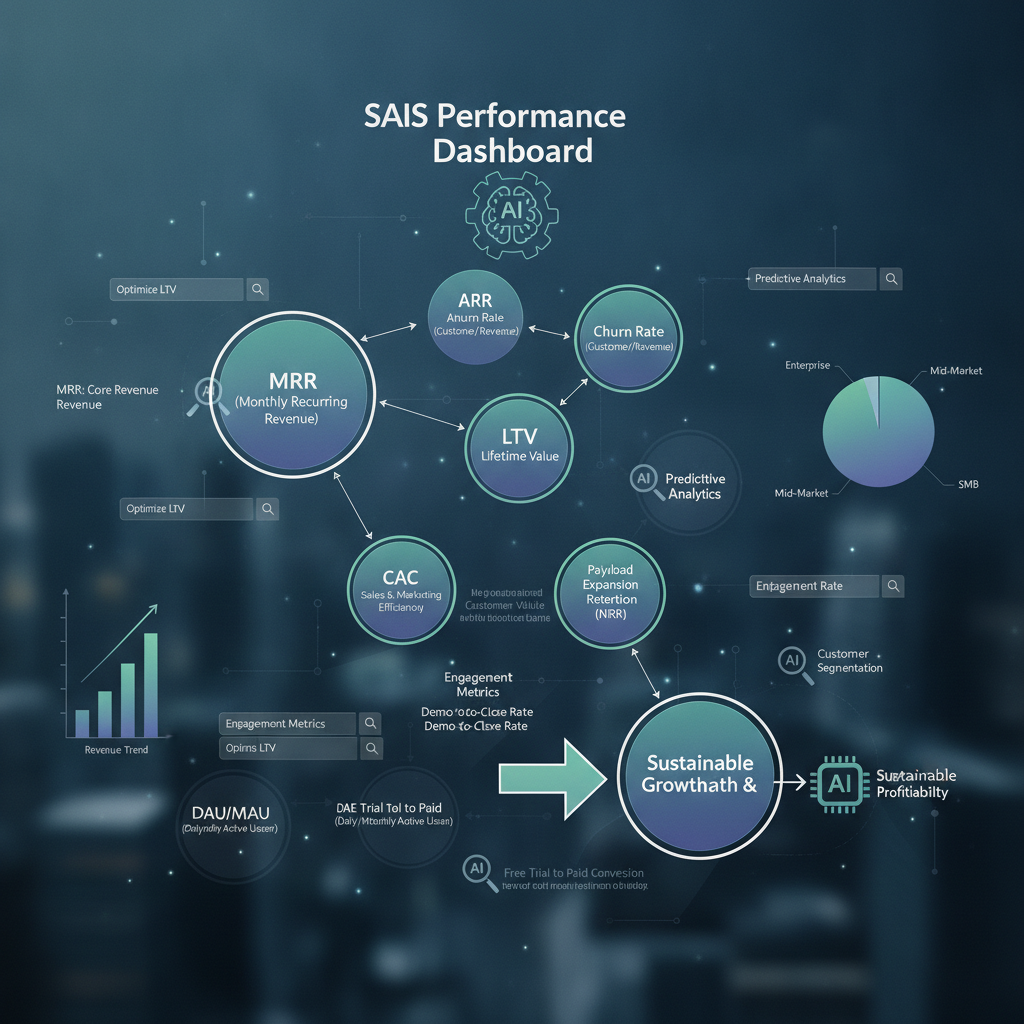
Pouring capital into advertising without a concrete understanding of your unit economics is a direct path to insolvency. This isn’t theoretical advice, it is financial reality. In the age of AI-driven search and zero-click discovery, the stakes are higher. Marketing can no longer operate in a vacuum. It demands ruthless efficiency and a clear tie to revenue. For SaaS founders, particularly those eyeing aggressive ad spend scaling, a deep dive into core revenue-tied metrics isn’t optional, it is fundamental.
The Non-Negotiable Foundation: Core Revenue-Tied Metrics
Before you commit another dollar to paid acquisition, understand what truly drives your business. These metrics dictate your capacity for sustainable growth.
Customer Acquisition Cost (CAC): Your True Investment
CAC represents the total cost to acquire a new customer. This includes all marketing, sales, and overhead expenses directly related to acquisition.
- Formula:
Total Sales & Marketing Costs / Number of New Customers Acquired - Why it matters: A high CAC erodes profitability. A low CAC allows for aggressive, sustainable scaling. Many founders miscalculate CAC, omitting crucial expenditures. Your finance team should reconcile this number quarterly.
Customer Lifetime Value (CLTV): The Long Game
CLTV projects the total revenue a customer will generate throughout their relationship with your company. This metric highlights the long-term value of your customer base.
- Formula:
(Average Revenue Per User * Gross Margin) / Churn Rate - Why it matters: CLTV provides the ceiling for your CAC. A healthy business targets a CLTV:CAC ratio of 3:1 or higher. Anything less means you are spending too much to acquire customers who do not deliver sufficient lifetime value.
Net Revenue Retention (NRR): Growth from Within
NRR measures the percentage of recurring revenue retained from existing customers over a period, accounting for upgrades, downgrades, and churn. This is the single most important metric for SaaS companies.
- Formula:
(Starting MRR + Expansion MRR - Downgrade MRR - Churned MRR) / Starting MRR - Why it matters: High NRR, ideally above 100%, indicates your existing customers are growing with you. It signifies product stickiness and effective customer success. You can scale without constantly chasing new logos. This is internal compounding growth.
Churn Rate: The Silent Killer
Churn rate quantifies the percentage of customers or revenue lost over a given period. There are two primary types: logo churn and revenue churn.
- Formula (Customer Churn):
(Customers Lost in Period / Customers at Start of Period) * 100 - Formula (Revenue Churn):
(MRR Lost from Churn in Period / MRR at Start of Period) * 100 - Why it matters: High churn rates negate new customer acquisition efforts. It’s like filling a leaky bucket. Addressing churn is often more cost-effective than acquiring new customers. Prioritize retention relentlessly.
Strategic Scaling in the AI Search Era
AI’s influence on search and content consumption is not a future threat, it is a present reality. Your measurement strategies must adapt.
Understanding the AI Conversion Shift
Traditional search once meant clicks to your website. AI-driven search, via large language models (LLMs), often delivers answers directly. This results in “zero-click discovery.” Your conversion path is no longer linear.
- Impact on Traditional Metrics: Direct website traffic may decrease. Top-of-funnel conversion rates might appear lower, even if brand awareness and implicit conversions increase.
- New Metric: LLM / AI Conversion Rate: This is an emerging concept. How do we measure the impact of being cited by an LLM? Track brand mentions, direct traffic spikes after LLM updates, and API calls if your content is directly consumed by AI models. This requires innovative attribution models.
Benchmarking for Aggressive Growth
Contextual benchmarks separate aspiration from achievable goals. What works for one SaaS model will fail for another.
The Rule of 40 is a fundamental health indicator for SaaS. It posits that a company’s growth rate percentage plus its EBITDA margin percentage should equal or exceed 40%.
- Formula:
Growth Rate % + EBITDA Margin % ≥ 40% - Application: This balances growth with profitability. Don’t chase growth at all costs, especially if it cripples your margins.
Average Contract Value (ACV) profoundly influences your metric benchmarks:
- Low ACV (< $1,000): Expect higher CAC, but prioritize self-serve models and low-touch sales. Focus on viral loops and product-led growth. CLTV must be significantly higher to offset acquisition costs.
- Mid ACV ($1,000 – $25,000): Blended sales and marketing efforts. Field sales become more viable. CAC will be higher than low ACV, but CLTV should follow suit.
- High ACV (> $25,000): High-touch sales and marketing. CAC will be substantial. NRR becomes paramount. Churn is devastating.
Channel-specific benchmarks: Your CAC will vary drastically by channel.
- Google Ads: Often higher intent, but competitive. Expect a higher CAC but potentially higher conversion rates.
- LinkedIn Ads: Excellent for B2B targeting, but expensive. CAC can be very high, but quality leads and larger deal sizes might justify it.
- Meta Ads: Broad reach, often lower intent. Lower CAC is possible, but lead quality requires robust qualification funnels.
| Metric Category | Traditional Focus | AI Search Era Adaptation |
|---|---|---|
| Customer Acquisition | Website Conversion Rate, CPC | LLM / AI Conversion Rate, Brand Mentions, Direct Referrals from AI summaries |
| Value Measurement | CLTV:CAC Ratio | CLTV:CAC adjusted for indirect AI influence, NRR as primary growth driver |
| Content Performance | Organic Rankings, Keyword Volume | Answer Engine Optimization (AEO), “Featured Snippet” dominance, Semantic Authority |
| Decision Criteria | Ad Platform ROI, Attribution Models | Probabilistic Attribution, Blended CAC, Influence Mapping in AI ecosystems |
Actionable Optimization: Beyond Tracking
Tracking metrics is only half the battle. Strategic action drives improvement.
Improving CAC and CLTV
- Refine Targeting: Ruthlessly narrow your ideal customer profile (ICP). Generic targeting wastes budget.
- Optimize Onboarding: A seamless onboarding process reduces early churn, boosting CLTV. First impressions matter immensely.
- Enhance Product Value: Continuously improve your product. Solve more problems, deliver more value. This is the ultimate retention strategy.
- Implement Referral Programs: Leveraged word-of-mouth reduces CAC significantly.
Boosting NRR and Reducing Churn
- Proactive Customer Success: Don’t wait for problems. Anticipate needs. Offer strategic guidance.
- Collect and Act on Feedback: Implement a robust feedback loop. Show customers their input drives product evolution.
- Strategic Pricing: Ensure your pricing aligns with value delivered. Consider usage-based or value-based tiers to facilitate expansion.
- Product Education: Ensure customers maximize product utility. Underutilization is a precursor to churn.
Tools for the Modern Marketer
Leverage technology to gain an edge. Manual data compilation is inefficient.
- Analytics & BI Platforms: Google Analytics 4, Amplitude, Mixpanel, Tableau, Power BI. Integrate these for a holistic view.
- CRM Systems: Salesforce, HubSpot. Centralize customer data. Enable consistent communication.
- Attribution Tools: Adjust, Branch. Understand true ROI across complex funnels.
- AI Content & SEO Platforms: Surfer SEO, SEMrush, Ahrefs, Clearscope. Optimize for both human and AI consumption.
- Revenue Operations (RevOps) Platforms: Consolidate sales, marketing, and customer success data. Provides a single source of truth for all revenue metrics.
Bottom Line
Scaling ad spend without a deep, actionable understanding of your revenue-tied metrics is not growth, it is gambling. In the AI era, this mandate is amplified. Measure what matters. Optimize relentlessly. Prioritize NRR. Understand your unit economics. This isn’t just about marketing; it is about building a durable, profitable business. Those who master these numbers will dominate. Everyone else will fund their competitors’ growth.
Frequently Asked Questions
What are the key revenue metrics SaaS founders should track before scaling ad spend?
SaaS founders must track Customer Acquisition Cost (CAC), Customer Lifetime Value (CLTV), Net Revenue Retention (NRR), and Churn Rate. These metrics are crucial for sustainable growth and profitability.
How is Customer Acquisition Cost (CAC) calculated and why is it important?
CAC is calculated as `Total Sales & Marketing Costs / Number of New Customers Acquired`. It’s important because a high CAC erodes profitability, while a low CAC enables sustainable scaling.
What is a healthy CLTV:CAC ratio for a SaaS business?
A healthy SaaS business typically targets a CLTV:CAC ratio of 3:1 or higher. This indicates that customers generate sufficient lifetime value compared to their acquisition cost.
Why is Net Revenue Retention (NRR) a critical metric for SaaS companies?
NRR measures the percentage of recurring revenue retained from existing customers, including upgrades, downgrades, and churn. An NRR above 100% signifies internal compounding growth, product stickiness, and reduces reliance on new customer acquisition.
How does AI-driven search impact traditional SaaS marketing metrics?
AI-driven search, via ‘zero-click discovery,’ can lead to decreased direct website traffic and lower top-of-funnel conversion rates. Marketers must adapt by tracking brand mentions and emerging ‘LLM / AI Conversion Rates.’
What is the ‘Rule of 40’ in SaaS and how is it applied?
The Rule of 40 is a health indicator stating that a SaaS company’s growth rate percentage plus its EBITDA margin percentage should equal or exceed 40%. It helps balance aggressive growth with profitability.