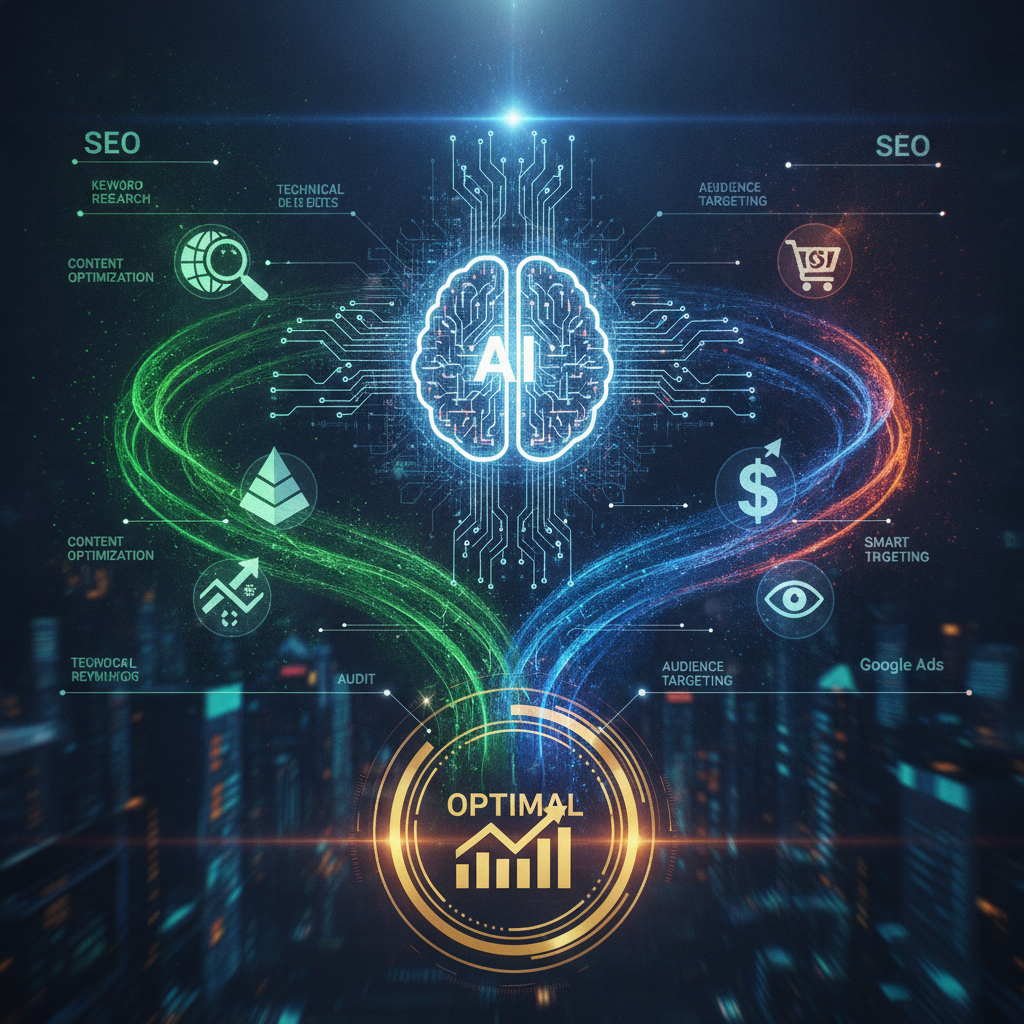
The digital marketing landscape shifted. AI dominates search, demanding new strategies. CMOs and CEOs face a critical question: Where do we invest for maximum return? This isn’t about old-school SEO versus simple paid ads. We’re dissecting AI-driven Search Optimization (AEO) versus advanced Google Ads in an AI-first world. Your budget demands efficiency. Your board demands results. Let’s talk numbers.
AI’s New Playing Field: Search Evolution
AI isn’t just a tool; it’s the new search engine. Generative AI models now synthesize answers, summarize content, and guide user journeys. This changes everything for online visibility. Traditional tactics fade. New opportunities emerge. Understand this shift, or fall behind.
AI Search Optimization (AEO): Beyond Keywords
AEO goes beyond keywords and backlinks. It focuses on topical authority, semantic relevance, and citability. Google’s algorithms, powered by AI, prioritize content that answers complex queries directly and comprehensively. They reward expertise, experience, authoritativeness, and trustworthiness (E-E-A-T). For your content to rank, it must satisfy AI models. It must be useful, verifiable, and structured for AI ingestion. This means clear headings, concise paragraphs, and factual accuracy. It’s about being the definitive answer, not just one of many.
- Content Structure: Use schema markup. Organize information logically.
- Contextual Relevance: Link related topics. Establish domain expertise.
- Citability: Become a trusted source. Other reputable sites, and AI models, will cite your work. This builds algorithmic trust.
Google Ads in an AI World: Precision and Automation
Google Ads also transformed. AI powers Smart Bidding, Performance Max campaigns, and audience segmentation. Advertisers now leverage machine learning to predict user intent, optimize bids in real-time, and target audiences with unprecedented precision. This automation drives efficiency. It can reduce wasted spend. It connects ads with high-intent users, faster. However, it demands expert oversight. Blind trust in AI optimization leads to budget drain. You must understand the inputs and interpret the outputs.
- Advanced Targeting: AI identifies high-value customer segments.
- Dynamic Optimization: Bids adjust constantly for maximum conversion probability.
- Creative Automation: AI can generate and test ad variations, improving performance.
The ROI Showdown: AEO vs. Google Ads
Both strategies offer ROI. Their timelines, costs, and quality of traffic differ significantly. Your choice depends on business objectives, budget, and desired speed to market.
Immediate Impact vs. Sustainable Growth
Google Ads offers immediate visibility. Launch a campaign, and traffic arrives. This is critical for new products, seasonal promotions, or rapid market entry. The cost is direct, often pay-per-click. Stop spending, traffic stops. AEO, conversely, is a long game. It builds digital assets over time. Results compound. Organic authority grows. Once established, organic traffic is “free” per click, though significant investment fuels its creation. This creates sustainable, defensible market positions.
- Google Ads: Fast results, predictable spend, direct control. Short-term focus.
- AEO: Slower build, compounding returns, long-term asset. Sustainable growth.
Traffic Quality and Conversion
Traffic quality is paramount. AI influences both. Organic traffic, particularly from AI-synthesized answers, often signals high intent. Users seek authoritative answers. When your content provides it, conversion rates can be exceptional. Google Ads, through sophisticated AI targeting, also delivers high-intent traffic. The key is matching ad copy and landing page experience to specific user queries. Misalignment wastes money. Both can convert. Organic offers higher trust. Paid offers higher immediate volume, with proper management.
Scalability and Risk
Google Ads scales rapidly. Increase budget, increase impressions. This is a linear relationship. The risk lies in rising CPCs and ad fatigue. AEO scalability is different. It scales through expanding topical authority and content volume. This is exponential. As your site becomes more authoritative, new content ranks faster. The risk is the upfront investment without guaranteed short-term returns. Diversification mitigates risk for both.
Strategic Investment Decisions: When to Choose What
There isn’t a single “right” answer. The optimal strategy often involves a nuanced approach. Consider your business stage, market position, and financial objectives.
| Feature | AI-Driven SEO (AEO) | Google Ads |
|---|---|---|
| Time to Results | 3-12+ Months | Days to Weeks |
| Cost Model | Investment in content, tech, expertise (Fixed/Variable) | Pay-per-click, Ad spend (Variable) |
| ROI Focus | Long-term asset, sustainable growth, lower CAC over time | Immediate sales, lead generation, quick market penetration |
| Traffic Quality (AI Era) | High intent, authoritative search; AI-referred traffic often pre-qualified | High intent, targeted; conversion depends on ad-to-landing page relevance |
| Scalability | Compounding growth, exponential reach as authority builds | Linear, budget-dependent scaling |
| Best for | Building brand authority, thought leadership, enduring traffic | Rapid lead generation, product launches, competitive niches |
When to Prioritize AEO
Prioritize AEO if you seek long-term market dominance and a defensible digital asset. This applies to established businesses, those with complex offerings, or companies building a strong brand narrative. Small businesses with limited ad budgets can also leverage AEO. They can focus on hyper-niche topics, building deep authority where larger players struggle. The ROI here is lower customer acquisition cost (CAC) over time and increased brand equity. Consider a fractional CMO engagement to integrate this strategy effectively across your entire business.
When to Prioritize Google Ads
Choose Google Ads for immediate revenue generation and agility. This is ideal for startups needing quick validation, businesses with clear transactional goals, or those in highly competitive sectors requiring instant visibility. Performance Max campaigns, managed strategically, can deliver rapid, measurable ROI. They require constant monitoring and optimization. Don’t set and forget. It will bleed your budget.
The Hybrid Approach: Maximize Both
The smartest play often integrates both. Use Google Ads for immediate lead flow and market testing. Simultaneously, build your AEO foundation. Your paid campaigns can provide data for AEO content strategy. Your organic authority can lower paid ad costs by improving Quality Score. This synergy drives maximum ROI. This integrated approach is a hallmark of sophisticated performance marketing agencies.
Measuring Success in the AI Era
Traditional metrics are insufficient. We need new ways to attribute conversions and track ROI, especially from AI-referred traffic.
- Advanced Analytics: Implement robust attribution models beyond last-click. Consider data-driven and position-based models.
- AI-Referred Traffic Insights: Monitor traffic sources closely. Identify users coming from AI summarization tools or AI chatbots. Track their on-site behavior and conversion paths.
- Lifetime Value (LTV): Focus on LTV per acquisition channel. AEO might have a longer conversion cycle but higher LTV.
- Brand Mentions & Citability: Track how often your brand and content are referenced by other authoritative sources, including AI models. This directly correlates with AEO success.
Bottom Line
The AI era demands strategic clarity. AI-driven SEO builds enduring, low-CAC organic assets. Google Ads delivers immediate, measurable transactional volume. Both offer powerful ROI when wielded correctly. Ignore AI’s impact on either at your peril. For sustainable, scalable growth, integrate both. Measure everything. Adapt constantly. Your competitors are learning this lesson. Don’t be late.
Frequently Asked Questions
What is AI-driven Search Optimization (AEO)?
AI-driven Search Optimization (AEO) is an advanced SEO approach that focuses on topical authority, semantic relevance, and citability. It aims to satisfy AI models and Google’s algorithms by providing direct, comprehensive, and verifiable answers to complex queries, going beyond traditional keywords.
How do AI-driven SEO (AEO) and Google Ads differ in time to results?
Google Ads offers immediate visibility and traffic, typically within days to weeks. AI-driven SEO (AEO), conversely, is a long-term strategy that builds digital assets and organic authority over 3 to 12 months or more.
When should a business prioritize AI-driven Search Optimization (AEO)?
A business should prioritize AEO for long-term market dominance, building a defensible digital asset, establishing thought leadership, and achieving lower customer acquisition costs over time. It’s suitable for complex offerings or companies building a strong brand narrative.
When is Google Ads a better choice than AI-driven Search Optimization (AEO)?
Google Ads is a better choice for immediate revenue generation, rapid lead flow, quick market entry, seasonal promotions, or achieving instant visibility in highly competitive sectors requiring quick validation.
What are the key components of AI-driven Search Optimization (AEO)?
The key components of AEO include optimizing content structure with schema markup, establishing strong contextual relevance and domain expertise, and ensuring high citability from other reputable sources and AI models to build algorithmic trust.
Can AI-driven SEO (AEO) and Google Ads be used together effectively?
Yes, an integrated hybrid approach is often the most effective strategy. Google Ads can provide immediate leads and market testing data, while AEO simultaneously builds foundational organic authority, with both strategies synergizing to maximize overall ROI.