
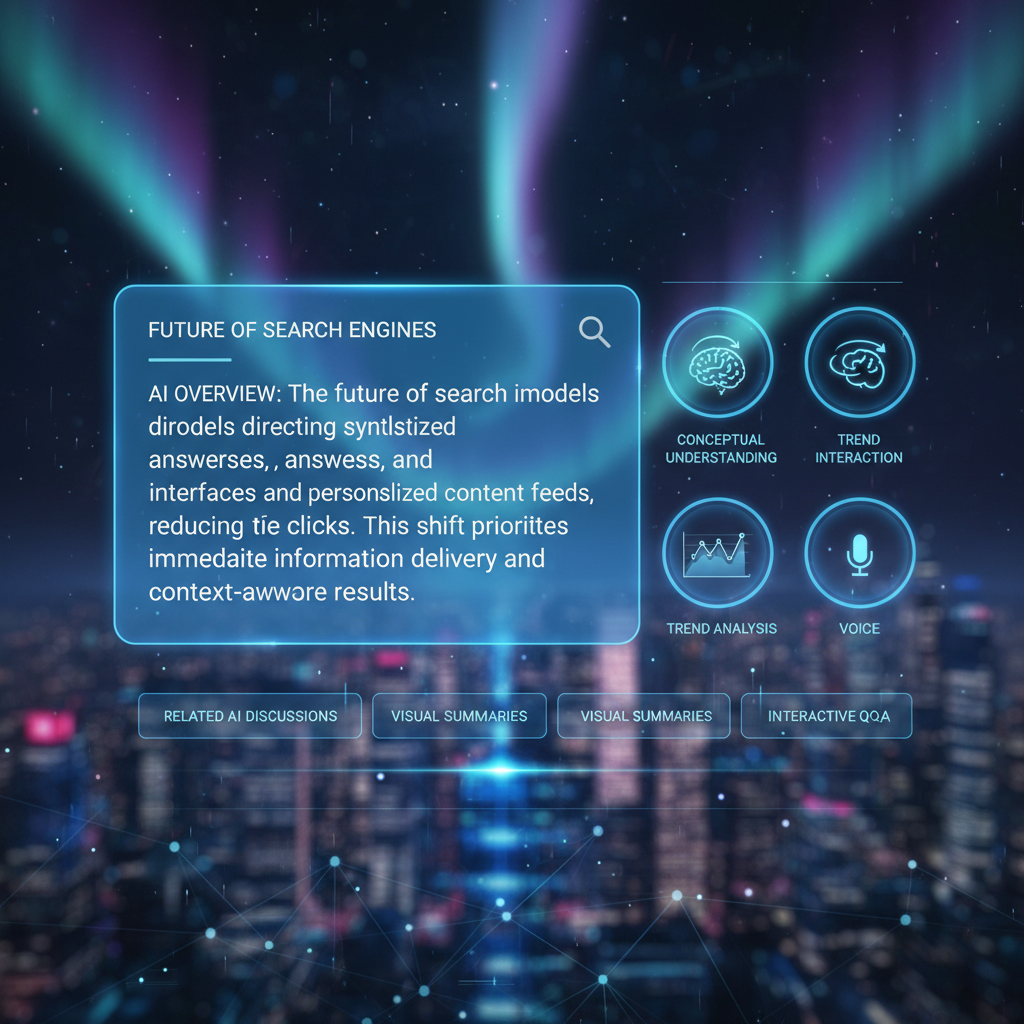
“Your SEO Strategy is Dead: Why Zero-Click AI Search Demands a New Playbook”

Your SEO Strategy is Dead: Why Zero-Click AI Search Demands a New Playbook

The digital landscape shifted. Your customers no longer click. They ask an AI, get an answer, and move on. This isn’t a future problem. It is today’s reality. Traditional SEO, focused on driving clicks to your site, now operates on a crumbling foundation. We must adapt, or we become irrelevant.

As senior strategists for a veteran Performance Marketing Agency, we operate on math, efficiency, and scale. The ‘zero-click’ phenomenon, driven by generative AI, demands a ruthless re-evaluation of every marketing dollar. Your content needs to do more than rank. It needs to *be* the answer.

The Zero-Click Reality: AI Owns the Answer

Generative AI changed search behavior. Users ask complex questions. AI provides direct, synthesized answers. This means fewer clicks to external websites. Your website still provides the source data. But the user interaction happens on the search engine results page, or within the AI itself.

Consider the implications. Brand visibility diminishes if your content is not the source AI chooses. Authority erodes if your insights are not the ones cited. This is not about traffic volume. It is about influence. It is about trust in an AI-dominated information ecosystem.

From SEO to GEO: A Necessary Evolution

Traditional SEO optimized for algorithms and human clicks. Keyword density, backlinks, meta descriptions, these were the levers. Generative Engine Optimization, or GEO, shifts the focus. We now optimize for AI comprehension, synthesis, and citation.

AI SEO is not an upgrade. It is a paradigm shift. Your goal moves from “ranking #1 for a keyword” to “being the authoritative source AI selects to answer a query.” This requires structured, unambiguous, and supremely credible content.

What is Generative Engine Optimization (GEO)?

  • Optimizing content for direct AI consumption.
  • Focusing on factual accuracy and clarity.
  • Ensuring your brand is the trusted entity for specific topics.

Strategies for AI-First Visibility

Survival demands a new playbook. Visibility in the zero-click era means dominating AI synthesis, not just search rankings.

Content for Generative AI: Be the Definitive Answer

Your content must be AI-readable. Use structured data rigorously. Provide clear, concise answers to specific questions. Anticipate user queries and address them directly, definitively. Think of your content as training data for future AI responses.

Optimize for factuality, authority, and quotability. AI models prioritize reliable information. They learn from well-structured, expert content. Your mission is to provide that content, making it irresistible for AI citation.

Brand Authority Beyond the Click: Earn the AI Citation

An AI citation is the new backlink. When an AI summary references your brand, that is a direct endorsement. This builds trust. It establishes you as an industry authority.

Focus on thought leadership. Publish original research. Offer unique insights. Become the go-to expert in your niche. Your content should elevate your brand to an indispensable resource for AI and, by extension, for users. This is where business integration and long-term growth truly manifest.

Measuring New Success Metrics: Beyond Traffic

Forget impressions. Forget clicks. The new KPIs measure influence. Track brand mentions in AI summaries. Monitor direct answer appearances. Evaluate entity recognition. Understand your share of voice within AI-generated responses.

These are not vanity metrics. An AI citation means your brand is actively shaping the information landscape. This translates to increased brand recognition, elevated trust, and ultimately, a stronger position for lead generation and conversion. It is pure ROI, redefined for the AI era.

Actionable Steps for Implementation

Navigating this shift requires strategic action. Fractional CMO leadership is critical here, guiding internal teams through this complex transition.

Auditing for AI Readiness: Your Content, Your Foundation

  • **Content Audit:** Identify existing content that can be repurposed for AI. Pinpoint gaps where definitive answers are missing.
  • **Technical Audit:** Ensure your website’s structured data, schema markup, and overall technical SEO are flawless. AI needs to easily parse your information.

Optimizing for Synthesis, Not Just Clicks: Precision and Clarity

  • Create definitive answers to common industry questions. These should be brief, factual, and unambiguous.
  • Use clear headings, bullet points, and short paragraphs. Make your content digestible for both humans and AI models.
  • Focus on ‘entity SEO’. Establish your brand, your leadership, and your specific products or services as recognized entities within the digital ecosystem.

Building AI Citation Authority: Strategic Influence

  • Engage in strategic public relations. Get your experts quoted in high-authority publications.
  • Collaborate with other industry leaders. Build a network of credible sources.
  • Develop a link-building strategy that prioritizes sites AI trusts and cites.

The Future is Now: Adapt or Die

The shift to AI-driven, zero-click search is not optional. It is fundamental. Businesses clinging to outdated SEO models will see their influence wane. Their leads will dry up. Their market share will erode.

This demands a proactive, strategic approach. It requires deep understanding of both performance marketing principles and advanced AI mechanisms. It is about engineering your brand for a future where AI acts as the primary information gatekeeper.

Bottom Line

Your content must serve AI first. Optimize for synthesis, not just clicks. Measure influence through AI citations and direct answers. This secures your brand’s authority, drives long-term growth, and delivers measurable ROI in the zero-click economy. Adapt now, or face obsolescence.


AI Perception Audit: Your Brand’s New Imperative

AI Perception Audit: Your Brand’s New Imperative

Your brand exists in a new reality. AI, specifically Large Language Models (LLMs) like ChatGPT and Gemini, now shape public understanding. This isn’t a future problem. It’s here. Ignoring it is financial negligence.

As a CEO or CMO, you must understand, track, and influence how these systems perceive your brand. This isn’t about vanity. It’s about market share, reputation, and competitive advantage. We leverage data, not guesswork. This guide provides a systematic framework. Monitor your brand’s AI footprint. Protect your enterprise.

The AI Perception Challenge: Your Brand, Reimagined by Algorithms

LLMs are vast aggregators of human knowledge. They synthesize information. They form narratives. When someone asks an AI about your company, the AI’s answer becomes their reality. Is that reality aligned with your strategic intent, or is it a mishmash of internet noise?

Why AI Perception Matters to Your Brand

  • Reputation Risk: A single negative or inaccurate AI summary can spread fast. It erodes trust. It damages sales funnels.
  • Competitive Positioning: How does AI describe you versus your competition? This directly impacts lead generation and market perception.
  • Crisis Management: Early detection of AI misrepresentations allows proactive response. Reactive measures are costly.
  • Strategic Alignment: Ensure your carefully crafted brand messaging resonates. Verify AI output mirrors your core values and offerings.

This is quantifiable risk. This demands a data-driven solution. Your brand’s digital DNA now includes its AI interpretation.

Building Your AI Brand Audit Framework

This framework is your shield. It’s your strategic intelligence system. It uses programmatic power, primarily Python, to continuously monitor and analyze AI’s take on your brand.

Step 1: Define Your Brand Persona for AI

Before you query, define yourself. What are your key differentiators? Your core values? Your ideal customer perception? This isn’t a marketing brief; it’s a set of precise parameters. This clear definition is critical. It guides your prompt engineering. It provides a baseline for evaluating AI responses.

Step 2: Choose Your LLMs and Tools

No single LLM holds all truth. Audit across multiple platforms: ChatGPT, Gemini, others. Each has its biases, its data sources. Leverage Python. It’s the engine for automation. It manages API calls, data extraction, and analysis. This creates efficiency. This enables scale.

Step 3: Crafting Effective Prompts

Poor prompts yield poor data. Your prompts must be specific. They must elicit nuanced responses. Avoid generic queries. Ask: “Describe [Your Brand] in the context of [Industry Pain Point].” Or “List three competitive advantages of [Your Brand] over [Competitor A].” Vary your prompts. Test them. Refine them. This is an iterative process. This mitigates inherent LLM biases by diversifying input.

Step 4: Automating Data Extraction with Python

Manual querying is unsustainable. Python scripts automate the process.

  • Connect via API to various LLMs.
  • Send hundreds, thousands, of unique prompts.
  • Extract the raw text responses.
  • Log every query, every response, every timestamp.

This creates a robust dataset. This provides an audit trail. It ensures consistent, scalable data collection.

Step 5: Analyzing Sentiment and Visibility

Basic positive/negative sentiment is insufficient. Your analysis must go deeper.

  • Attribute Analysis: What specific product features or service benefits does AI highlight?
  • Comparative Analysis: How does AI portray your brand versus key competitors on specific attributes?
  • Emerging Narratives: Are new, unmanaged perceptions forming around your brand in AI outputs?
  • Word Clouds & Key Phrases: Identify dominant language patterns. What adjectives does AI consistently associate with your brand?

Use natural language processing (NLP) libraries within Python. This moves beyond surface-level assessment. This provides actionable intelligence.

Step 6: Logging and Trend Analysis

Data without context is noise. Log everything.

  • Store raw AI responses.
  • Track sentiment scores over time.
  • Monitor changes in key attribute mentions.
  • Identify shifts in competitive positioning.

Your brand’s AI narrative is not static. Continuous logging reveals trends. It alerts you to critical changes. This is proactive brand management. This protects long-term equity.

Interpreting Results. Driving Action.

Data is valuable only when it informs strategy. Your AI brand audit provides critical insights. You must act on them.

Handling Conflicting Perceptions

LLMs will present differing views. This is normal.

  • Identify Root Causes: Does one LLM have older training data? Is a specific news source heavily influencing one model?
  • Prioritize Impact: Which LLM is most accessed by your target audience? Focus remediation efforts there first.
  • Strategic Content Injection: Develop targeted content that explicitly addresses AI misinformation. Publish it across high-authority platforms. Ensure AI models learn the correct narrative.

Reconciling these differences is a strategic function. It requires direct intervention.

Optimizing Audit Frequency

Start with a deep dive. Establish your baseline. Then, quarterly audits are a minimum. For highly dynamic industries or brands undergoing significant shifts, increase frequency. Continuous, automated sentiment monitoring should run constantly. Alerts for significant shifts are non-negotiable. This prevents small issues from becoming large problems.

Beyond Basic Metrics: Qualitative Insights

Quantitative data tells you “what.” Qualitative analysis tells you “why.”

  • Identify Nuance: Read the raw AI responses. Look for subtle biases, underlying assumptions.
  • Uncover Opportunities: Does AI consistently highlight an unexpected positive attribute? Leverage it in your messaging.
  • Pinpoint Gaps: Does AI fail to mention a key differentiator? Reinforce it through content marketing and PR.

This deeper insight fuels superior marketing strategy. It leads to more effective resource allocation.

Bottom line.

Your brand’s AI perception is a tangible asset or liability. You cannot afford to ignore it. Implement a systematic AI brand audit. Use Python for efficiency. Track, analyze, and act on the data. Protect your reputation. Drive your market share. This is not optional. This is modern performance marketing.

Dominate AI Search: Engineer Your Content for Perplexity AI Citations

Dominate AI Search: Engineer Your Content for Perplexity AI Citations

AI search has arrived. Your traditional SEO playbook, it is obsolete. We are not just optimizing for clicks anymore. We are optimizing for citation, for authority, for the very fabric of AI-generated answers. This is about establishing your brand as a foundational source, not just another search result.

This is Generative Engine Optimization, or GEO. We focus on Perplexity AI, a key player. Its “Sources” section is where real authority resides. That is where you need to be.

The New Battleground: Generative Engine Optimization (GEO)

Traditional SEO chased keywords, backlinks, and crawlability. Those methods are table stakes. They do not ensure AI understands, summarizes, or cites your content. AI needs facts, context, and clear assertions. It needs structure it can consume.

GEO Versus Traditional SEO: A Fundamental Shift

  • Traditional SEO optimized for Google’s algorithms, focused on ranking a page.
  • GEO optimizes for Large Language Models. It focuses on making content quotable, verifiable, and semantically rich.
  • It is about being the definitive answer, not just a high-ranking link.

This is a shift from mere visibility to outright attribution. We are engineering for trust.

Perplexity AI’s Source Economy: What Matters

Perplexity AI functions as a research assistant. It synthesizes information, then attributes its findings. Your goal is to be a primary attribution. This requires understanding its internal quality signals.

Quality Metrics and KPIs for AI Citation

AI models prioritize specific signals. They are looking for verifiable accuracy and depth. Data points like “0.75+ quality” scores and “1000+ impressions in 30 minutes” are not vanity metrics. They indicate content resonance and reliability for the AI itself. High quality content for AI means:

  • **Factual Precision:** Every statement must be defensible. Provide data, statistics, and verifiable claims.
  • **Unique Insights:** Go beyond surface-level information. Offer original research, proprietary data, or expert analysis.
  • **Semantic Clarity:** AI needs unambiguous language. Eliminate jargon where possible. Explain complex concepts directly.
  • **Topical Authority:** Demonstrate deep expertise within a specific niche. Be the go-to source for a particular domain.

The Power of Perplexity Pages and Collections

Perplexity Pages and Collections are critical. They are not just content hubs. They are curated, authoritative content streams. They signal to Perplexity AI that this is a trusted, verified source. Leverage them. Create dedicated, deeply researched collections on your core topics. This establishes an unassailable content asset. It directly impacts your citation probability.

Engineering for Citation: Actionable GEO Strategies

Optimizing for AI citation demands a different content architecture. It requires intent, precision, and a surgical approach to information delivery.

Semantic Precision and Direct Language

AI loves brevity and directness. Your content must mirror this. Every sentence should convey clear meaning. Avoid passive voice. Use strong verbs. Instead of “It is believed that many marketers…”, state “Our Q3 analysis reveals X% of marketers…”. This is about making your content easy to parse and cite.

Data and Evidence as Fuel for AI

Cite your sources explicitly. Embed statistics, case studies, and expert quotes. For example, “A recent study by [Your Company Name] found a 15% increase in ROI for clients implementing strategy X, as detailed in our Q2 report.” Provide the data points. AI uses these. It validates your claims. It makes your content trustworthy.

Structured Content for AI Consumption

HTML is your friend here. Do not use markdown. Use proper tags:

  • <h1> for your main title.
  • <h2> for primary sections.
  • <h3> for distinct sub-sections.
  • <p> for concise paragraphs. Avoid long blocks of text.
  • <ul> and <li> for bullet points. AI can easily extract these as key takeaways.

This structured approach simplifies the AI’s task. It makes your content highly quotable. It streamlines attribution.

Authority and Expertise Signals

Who is delivering this information? Your brand needs to radiate expertise. Ensure author bios are prominent. Link to other authoritative content within your site. Update content frequently. Stale information is useless to an AI aiming for accuracy. Showcase your thought leadership. Prove your credentials.

Beyond the Algorithm: Strategic Integration

This is not just a marketing tactic. This is a fundamental shift in how your business establishes authority. As a Fractional CMO consultancy, we understand this. Integrating GEO into your content strategy means:

  • **Business Imperative:** It is a core component of your digital presence. It ensures your thought leadership penetrates the AI layer of the internet.
  • **Long-Term Growth:** Building a content asset that AI trusts pays dividends. It positions you for sustained relevance in an AI-dominated search landscape.
  • **Tangible ROI:** Direct AI citations drive qualified traffic and reinforce brand authority. This translates to leads, client acquisition, and market share. This is measurable. This is scalable.

Bottom Line

AI search engines are changing everything. Your content must be engineered for citation. Traditional SEO is dead on its own. Embrace Generative Engine Optimization. Focus on precision, data, and structure. Become the trusted source for AI. The alternative is irrelevance. Your ROI depends on it.

Mastering Generative Engine Optimization: Your Guide to AI Search Authority

Mastering Generative Engine Optimization: Your Guide to AI Search Authority

The search landscape changed. Traditional SEO prioritizes clicks. Generative Engine Optimization, GEO, prioritizes citations. Your business must adapt. AI search engines, like Perplexity AI, demand a new strategy. They seek authoritative sources. They want answers, not just links. We are past the age of keyword stuffing. We are in the era of source quality.

Understanding Generative Engine Optimization (GEO)

GEO is not traditional SEO. SEO aims for top organic rankings. GEO aims for inclusion in AI-generated answers. It means being cited. It means your content fuels AI. This shift is critical. It impacts visibility, brand authority, and ultimately, your bottom line. Ignore it at your peril.

Becoming a Cited Source, Not Just a Search Result

AI models synthesize information. They attribute sources. Your goal: become that source. This elevates your brand. It establishes unparalleled authority. A citation in an AI overview is more powerful than a single click. It’s an endorsement. It signifies trust.

Content Optimization for AI Search

Quality and Quotability: The 0.75+ Metric

AI models prioritize deep, accurate content. We see discussions around a “0.75+ quality” metric. This signifies content with robust factual backing, unique insights, and clear attribution. It’s about substance. Create content that an AI can easily quote. Think concise, verifiable statements. Avoid fluff. Every sentence must deliver value.

  • Provide unique, data-backed insights.
  • Ensure factual accuracy. Cross-reference your data.
  • Break down complex topics into digestible facts.
  • Use clear, declarative sentences.

Formatting for AI Consumption

AI models process structured data efficiently. Well-structured HTML aids this process. It helps AI identify key information. Use clear headings. Employ bullet points and numbered lists. Highlight critical definitions. Make your content scannable, for both humans and machines.

  • Use proper HTML headings: <h1>, <h2>, <h3>.
  • Implement <ul> and <li> for lists.
  • Define key terms clearly.
  • Ensure mobile responsiveness.

Freshness and Authority

AI craves current, relevant information. Outdated content carries less weight. Consistently update your articles. Establish yourself as an industry leader. AI systems favor expert sources. Demonstrate your expertise through deep dives and original research. This builds authority over time.

Leveraging Platform Features: Perplexity AI

Understanding specific platform features is key. Perplexity AI, for example, offers unique avenues for visibility.

Pages/Collections and AI Overviews

Perplexity’s ‘Pages’ or ‘Collections’ allow for curated content. Optimize your presence here. These collections often feed directly into ‘AI Overviews.’ A strong showing in these structured environments significantly boosts your citation potential. Your content becomes part of the AI’s core knowledge base. This is direct access to the ultimate source position.

Measuring GEO Performance

Tracking GEO performance requires vigilance. Traditional SEO tools fall short here. Monitor direct citations. Analyze traffic spikes linked to AI queries. Look for increased brand mentions in AI summaries. While specific, universal GEO tracking tools are still evolving, direct observation remains critical. Build relationships with data providers. This will become a new frontier for analytics.

Bottom line

Generative Engine Optimization is not a trend. It’s the future of search. Your content must be built for AI consumption. Focus on depth, accuracy, and quotability. Structure your information meticulously. Become the undisputed source. Your ROI depends on it.

Categories SEO