From SEO to GEO: Mastering Zero-Click Search in the AI Era

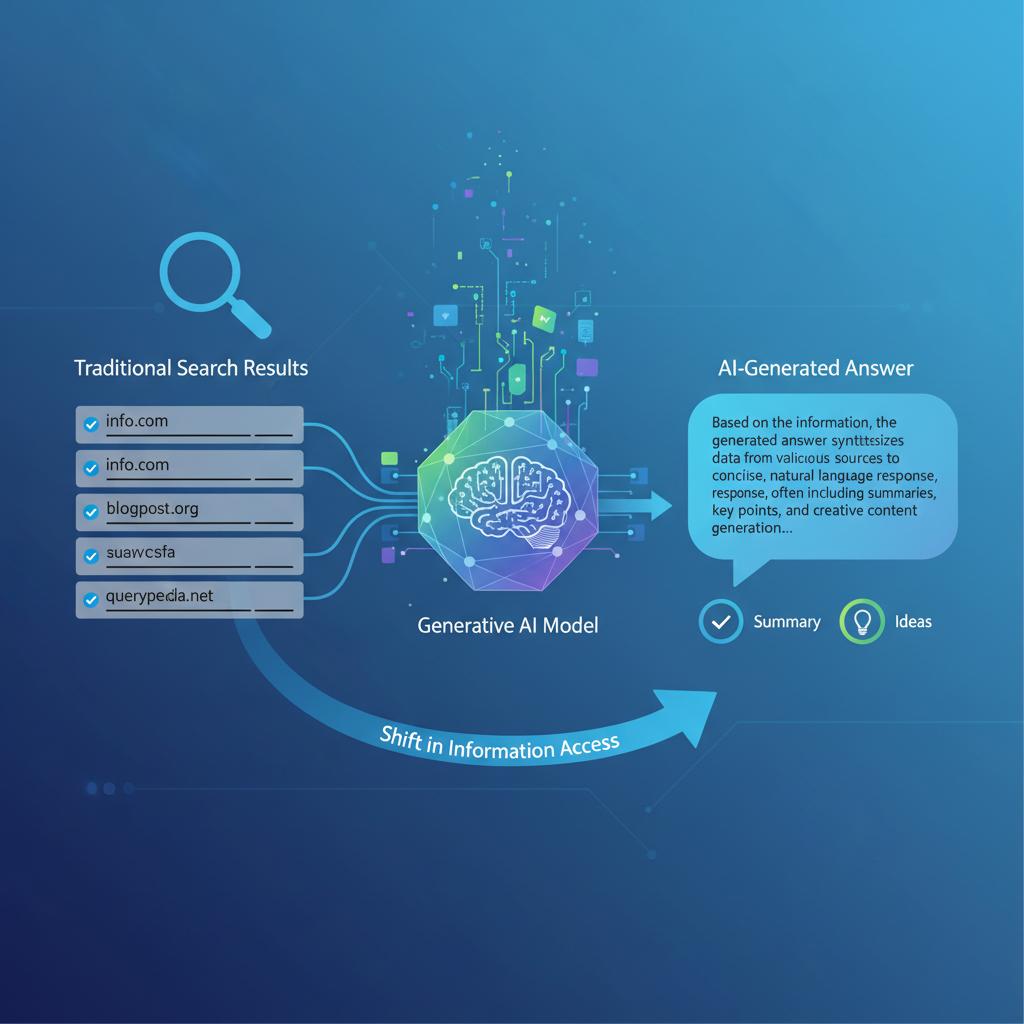
The search landscape changed. Generative AI delivered the first blow. Now, users get direct answers. Clicks dwindle. Traditional SEO, your trusted weapon, is blunted. This is the zero-click reality. Ignore it, and your brand disappears.

The Zero-Click Reality: Your Brand’s New Battleground

Users ask. AI answers. Search engines, once gateways, are becoming answer engines. This phenomenon, “zero-click search,” means users find information without ever visiting your website. Data confirms it. Over half of all Google searches now result in no clicks to external sites. This is not a trend. This is the new baseline.

For performance marketers, this shift is brutal. Traffic metrics plummet. Organic visibility, once a pillar, crumbles. Your brand, your content, your carefully crafted SEO strategy, becomes invisible when AI summarizes the answer.

Generative AI: The New Gatekeeper of Information

Generative AI models, like those powering Google’s SGE or ChatGPT, are sophisticated. They don’t just index keywords. They understand context. They identify entities. They synthesize information from vast datasets. They answer questions directly. Your content must speak to these machines, not just to humans scrolling past ads.

The AI prioritizes authority, factual accuracy, and unique insights. It curates. It verifies. If your content lacks these elements, it will be ignored. Your competitors, the smart ones, are already adapting.

Generative Engine Optimization (GEO): The Imperative for Survival

SEO optimized for human search queries. GEO optimizes for AI comprehension and citation. It is a fundamental shift. It is about becoming an authoritative source that AI models must reference. This is not about tricks. It is about fundamental content quality and strategic authority building.

Your goal: establish your brand as an “AI-verified knowledge node.” This is where your brand’s expertise becomes indispensable to the AI’s answer generation process. Without this, you lose. It is that simple.

Actionable GEO Strategies for the C-Suite

1. Create Content for AI Citation: Unique, Data-Driven Insights

AI does not cite generalities. It cites specifics. It references novel insights, proprietary data, and expert analysis. Your content must be the source of truth, not just another voice in the chorus.

  • Proprietary Research: Conduct original studies. Publish your findings. For example, “A Vicious Marketing Analysis of 10,000 Micro-Influencer Campaigns Reveals a 3x ROI Increase with Niche Segmentation.” Provide the data.
  • Data Visualization: Present complex data in simple, digestible formats, like tables or infographics. AI can parse these efficiently.
  • Expert Interviews and Quotes: Quote internal and external subject matter experts. AI values credible human authority.
  • Structured Answers: Present information in clear, concise, declarative sentences. Use headings and bullet points. Make it easy for AI to extract facts.

Example of AI-Friendly Data Presentation:

Strategy Element Traditional SEO Focus Generative Engine Optimization (GEO) Focus
Content Goal Rank for keywords, drive clicks Be cited by AI, establish authority
Audience Human searchers AI models and human searchers
Key Metric Website traffic, CTR, rankings AI mentions, entity prominence, brand authority

2. Entity Optimization: Beyond Keywords

Keywords are still relevant. Entities are paramount. An entity is a distinct thing: a person, organization, concept, product. AI understands relationships between entities. Optimize for them.

  • Identify Core Entities: What are the central concepts, people, and brands relevant to your business? Map them.
  • Build Entity Profiles: Create comprehensive, authoritative content around these entities. Define them clearly. Describe their attributes. State their relationships.
  • Semantic Markup: Use Schema.org markup. Tag your content, organizations, products, and services. This gives AI structured data it can easily process and verify.
  • Internal and External Linking: Link to and from other authoritative sources when discussing entities. This reinforces their legitimacy and context for AI.

Practical Tools: Leverage Google’s Natural Language API for entity extraction. Use knowledge graph databases to understand how entities are connected. These insights inform your content strategy.

3. Securing Presence in AI-Verified Knowledge Nodes

AI learns from authoritative sources. To be cited, you must be associated with these sources. This is about building digital authority and trust.

  • Wikipedia and Knowledge Panels: Earn a presence. This requires verifiable, neutral, and well-sourced information about your brand and its key figures. It is not easy. It is critical.
  • Industry Databases: Ensure your brand is accurately listed in relevant industry directories and professional databases. These are trusted data points for AI.
  • Academic and Research Citations: If applicable, publish or be cited in academic papers. This signals high-level expertise and research rigor.
  • E-E-A-T Reinforcement: Constantly demonstrate your Experience, Expertise, Authoritativeness, and Trustworthiness across all digital touchpoints. AI algorithms weigh these signals heavily.

4. The Role of Paid Autonomous Ads

Imagine ads served by AI, directly in response to complex user needs, not just search queries. This is the future. “Paid autonomous ads” will bypass traditional platforms. They will integrate directly into the AI’s answer generation.

Preparation is key. Develop ad copy that is contextual, highly relevant, and offers clear value. Focus on audience intent, not just keywords. Be ready for AI-driven bidding and placement. This will redefine ad spend ROI.

5. Measuring Success in a Zero-Click Environment

Traditional KPIs are obsolete. New metrics are essential for tracking GEO effectiveness.

  • AI Mentions and Citations: Track how often AI models reference your brand or content. This is a direct measure of your authoritative presence.
  • Branded Search Volume (Post-AI): An increase in direct branded searches after AI exposure indicates successful brand awareness and validation.
  • Direct Traffic and Engagement: Users who get initial answers from AI may still seek your site for deeper engagement, product information, or conversion. Track this downstream traffic.
  • Conversion Rate on Branded Traffic: If AI validates your brand, users arriving directly should convert at a higher rate.
  • Knowledge Panel and Entity Graph Presence: Monitor the visibility and accuracy of your brand’s presence in AI-generated knowledge panels and entity graphs.

These metrics focus on influence, authority, and downstream impact. They measure the ROI of your AI visibility, not just vanity clicks.

Strategic Integration: Fractional Leadership and Long-Term Growth

The transition to GEO is not a marketing tactic. It is a business strategy. It requires integrating content, data, and technology. A Fractional CMO, leveraging deep industry expertise, can lead this pivot.

They bring the strategic foresight to redefine your digital presence. They ensure your brand’s long-term growth by aligning your content strategy with the realities of an AI-first search world. This is about future-proofing your business, not just optimizing a campaign.

Bottom Line

Zero-click search is here. Generative AI is the new arbiter of information. Adapt or become irrelevant. Implement Generative Engine Optimization. Focus on being an AI-cited authority. Measure your influence, not just your clicks. Your brand’s survival depends on it.

AI Perception Audits: Control Your Brand Narrative in the Age of LLMs

Artificial intelligence shapes market perception. Today, LLMs dictate how your brand is seen. This is not optional. It is a critical business function. Understanding how these models interpret and describe your entity is paramount. Ignore this at your peril. Your brand’s digital footprint extends beyond traditional search. It now lives in AI outputs. Control that narrative, or lose it.

The Imperative: Why AI Perception Audits Matter

Your brand’s value is finite. AI models influence that value daily. They dictate customer understanding, market sentiment, and competitive positioning. A systematic audit process assesses AI interpretation. It identifies discrepancies. It ensures your message remains consistent, even as AI evolves. This is not about vanity metrics. It is about measurable ROI. Misinformation, even subtle, costs money. It erodes trust. It damages market share. An AI perception audit provides the data to prevent that.

Beyond Keywords: What AI Perception Auditing Entails

This is a deep dive. It goes past basic SEO. We are examining the very fabric of AI understanding. An effective audit covers several key areas:

  • Model Interpretation: How do different LLMs describe your brand, products, or services?
  • Sentiment Analysis: What is the prevailing emotional tone associated with your entity across AI outputs?
  • Visibility and Prominence: How often and where does your entity appear in relevant AI-generated content?
  • Brand Consistency: Is the AI narrative aligned with your core messaging and values?
  • Bias Detection: Are there any unintentional biases in how AI portrays your brand?

Each point represents a potential leak in your brand’s value. Seal those leaks with data.

Executing the Audit: A Practical Framework

Precision is power. A structured approach yields actionable insights. Follow these steps:

  1. Define Scope and Entities: Identify specific brands, products, or key personnel to audit. Be granular.
  2. Select AI Models: Choose the LLMs most relevant to your audience and industry. Prioritize.
  3. Data Extraction Strategy: Develop methods to programmatically query AI models. This often involves APIs and custom scripts. Python is your friend here.
  4. Data Analysis and Quantification: Process the extracted data. This is where the math happens.
  5. Reporting and Strategic Recommendations: Translate data into business intelligence. Formulate actionable steps.

Tools of Engagement: Leveraging Python and APIs

Manual review is impossible. Automation is essential. Python, coupled with AI provider APIs, offers the necessary scalability and precision. You will need:

  • API Access: Direct interfaces to models like OpenAI, Google Gemini, or other relevant LLMs.
  • Python Libraries: Tools for making API requests, parsing JSON, and conducting natural language processing (NLP). Think requests, json, nltk, spaCy.
  • Data Storage: A robust system to store and organize AI outputs for analysis.
  • Analytical Frameworks: Custom scripts to quantify sentiment, detect patterns, and measure consistency. This requires a skilled data scientist or a fractional analytics leader.

Without these tools, your audit is guesswork. Guesswork is expensive.

Quantifying Perception: Metrics and Measurement

ROI demands numbers. Vague insights are useless. Key metrics include:

  • Sentiment Score: A quantifiable measure of positive, negative, or neutral mentions. Track trends over time.
  • Prominence Index: How often your entity appears relative to competitors or other topics.
  • Attribute Association Frequency: What adjectives, verbs, or concepts are most commonly linked to your brand by AI?
  • Narrative Deviation Score: A metric indicating how much AI-generated content deviates from your approved brand guidelines.

These metrics provide a baseline. They enable benchmarking. They show progress, or lack thereof. This is how you prove value.

Challenges and Mitigations

No process is perfect. AI perception auditing presents unique challenges. Address them head-on:

Challenge Mitigation Strategy
AI Model Bias Audit multiple models. Cross-reference outputs. Adjust for known model tendencies.
Data Volume & Noise Implement robust filtering. Prioritize relevant AI outputs. Refine queries.
Evolving AI Capabilities Regularly update audit methodologies. Stay current with API changes and model advancements. Continuous vigilance is key.
Lack of Benchmarking Data Establish internal baselines. Compare against competitor performance where feasible. Share anonymized best practices within a trusted network.

Anticipate these roadblocks. Plan for them. It saves time. It saves money.

Strategic Impact: Turning Insights into Growth

An audit is not an end. It is a beginning. The data derived from AI perception audits directly informs your marketing strategy, product development, and overall brand management.

  • Content Strategy: Adjust your messaging to align with desired AI interpretation. Optimize for AI comprehension, not just human readability.
  • Reputation Management: Proactively address negative sentiment or inaccurate information propagated by AI.
  • Competitive Advantage: Identify gaps where competitors are misrepresented, or where your brand can dominate AI narratives.
  • Product Development: Understand how AI perceives your product features, informing future iterations.
  • Fractional CMO Insight: Use these audits to provide executive-level guidance on brand health and digital strategy, ensuring long-term growth and market relevance. This is strategic oversight, not just tactical execution.

These insights drive revenue. They secure market position.

Bottom Line

AI models are the new gatekeepers of brand perception. Ignoring their influence is a critical error. Implement rigorous AI perception audits. Use data, not intuition, to guide your strategy. Control your brand’s narrative in the age of generative AI. This is a strategic imperative. Your bottom line depends on it.

Mastering AI Search: How to Be a Source, Not Just a Click

The internet changed. Again. AI search engines are here. They are not just ranking pages; they are synthesizing answers. They cite sources. Your business needs to be one of them. Chasing clicks is dead; earning citations is the new game.

The Generative Engine Optimization Imperative

Traditional SEO focused on keywords and backlinks, driving traffic to your site. Generative Engine Optimization, GEO, plays a different game. AI models like Perplexity AI scan the web. They extract facts. They synthesize responses. They then provide a list of sources. Our goal, as performance marketers, is simple: be a top source.

Why Source Citations Trump Organic Clicks

CEOs and CMOs care about authority and trust. Being cited by an AI search engine signals both. It positions your brand as a definitive voice. It builds top-of-funnel awareness and credibility that a mere click often fails to deliver. This is about establishing expertise, not just traffic volume.

Actionable Strategies for AI Citation-Worthiness

This is not theoretical. This requires a surgical approach to content.

1. Content Quality and Freshness: The Foundation

AI models prioritize accuracy and timeliness. Your content must be impeccable, current, and fact-checked. The AI is looking for objective truth, not opinion.

  • Data-Driven Insights: Provide original research, proprietary data, or unique interpretations of public data. Quantifiable value makes you quotable.
  • Expert Authorship: Ensure content is authored by recognized experts. AI assesses author authority.
  • Rigorous Editing: Eliminate ambiguity. AI needs clarity. Target a consistent “0.75+ quality” metric, which means precise language, verifiable facts, and no filler. This is achieved through brutal self-editing and subject matter expert review.

2. Strategic Content Structure: Built for AI Parsing

AI search engines parse the web for concise answers. Your content must facilitate this. Think machine readability, not just human readability.

  • Direct Answers: Provide immediate, clear answers to common questions at the top of your content. Do not make the AI dig.
  • Clear Headings and Subheadings: Use HTML <h2> and <h3> tags. These serve as signposts for AI, delineating key topics and sub-topics.
  • Bullet Points and Numbered Lists: These formats are easily digestible for AI. They extract information efficiently, ideal for generative overviews.
  • Definitive Summaries: Conclude sections, or the entire article, with a concise summary statement. These are prime candidates for AI extraction.

3. Velocity and Visibility: Earning Early Impressions

Speed matters. AI models favor fresh, high-impact content. Achieving “1000+ impressions in 30 minutes” signals immediate relevance and authority to the algorithms. This is not passive SEO.

  • Rapid Indexing: Ensure your technical SEO allows for immediate indexing upon publication.
  • Strategic Distribution: Leverage your owned channels, email lists, and social platforms for immediate amplification. Consider targeted paid promotion for initial velocity.
  • Topical Authority Clusters: Create comprehensive content clusters around key themes. This signals deep expertise to AI, making your entire domain more citation-worthy.

4. The Zero-Click AI Search Strategy

This is counter-intuitive for some, but essential for AI search. Your goal is to provide the best possible answer directly within the search result, often without a click. The value comes from brand omnipresence and authority. Your name, your agency, is the definitive answer.

  • Concise Definitions: Define core concepts clearly.
  • Fact Boxes: Highlight key statistics or facts prominently.
  • Semantic Optimization: Understand the intent behind AI queries. Structure content to directly address those intents with precision.

The Perplexity AI Enigma: What We Prioritize

Perplexity AI, a leader in AI search, does not publicly disclose its exact citation criteria. However, observed behavior and logical inference point to several critical factors.

  • Factual Accuracy: Non-negotiable.
  • Authoritative Source: Domain reputation, author expertise.
  • Conciseness and Clarity: Easily extractable answers.
  • Timeliness: Up-to-date information.
  • Semantic Relevance: How well the content directly answers the query intent.

Our approach at Vicious Marketing and EDC builds strategies around these inferred priorities. We adapt as the AI landscape evolves.

Bottom Line

AI search has redefined content value. Clicks are vanity; citations are sanity. Your content must be accurate, precise, timely, and expertly structured. This secures your position as a trusted source. This is how you win in the new era of generative AI. This is how you drive real ROI.

Generative Engine Optimization: Why Your SEO Strategy Just Changed Forever

The search landscape changed. It is not just about rankings anymore. Traditional SEO, while still critical, addresses only part of the equation. We now optimize for artificial intelligence.

Traditional SEO: The Old Playbook

For decades, SEO meant getting your website to the top of Google’s search results. We chased keywords. We built backlinks. We optimized meta descriptions. The goal was simple, appear high on a list of blue links. Your website was the destination.

This approach drove traffic. It generated leads. It delivered ROI. We perfected the system, measuring every click and conversion. This remains foundational. Ignore it at your peril.

Enter Generative Engine Optimization (GEO)

What GEO Means

Generative Engine Optimization, or GEO, is a new discipline. It prepares your content for AI-powered search experiences. Think beyond the blue links. Think AI-synthesized answers. Your content does not just rank, it gets included in the AI’s direct response. It becomes part of the generated answer, often with attribution.

This is a fundamental shift. Google’s Search Generative Experience (SGE) and other AI models are summarizing information. They are answering questions directly. Your content must be ready for this synthesis.

Why GEO Matters Now

Users expect immediate, comprehensive answers. AI delivers this. Businesses that fail to adapt will lose visibility. They will lose influence. They will lose market share. Your content needs to feed the AI, not just lure a click.

This is not a future problem. It is a present challenge. CEOs and CMOs must integrate GEO into their performance marketing strategies. The math demands it. Efficiency dictates it. Scale depends on it.

GEO vs. SEO: The Fundamental Shift

Understand the distinction. This is not a replacement, it is an evolution. SEO targets the traditional SERP. GEO targets the AI’s answer box, the generative output.

Ranking vs. Inclusion

  • SEO Goal: Achieve a high position in a list of web pages. Drive traffic to your site.
  • GEO Goal: Be accurately cited or integrated into an AI-generated answer. Influence the AI’s understanding of a topic.

Your content must be authoritative enough for an AI to quote it. It must be structured enough for an AI to extract key facts. This is a higher bar.

The Signal, Not Just The Source

Traditional SEO focused on the source, your website. GEO focuses on the signal your content sends to an AI. Is it clear, concise, and factually robust? Can an AI easily process and summarize it?

This also relates to Answer Engine Optimization (AEO), which is a subset focused on specific direct answers. GEO is broader, encompassing the entire generative experience, including summaries and conversational AI responses.

The Quality Imperative: E-E-A-T Redux

Experience, Expertise, Authoritativeness, and Trustworthiness (E-E-A-T) always mattered. With GEO, E-E-A-T is non-negotiable. AI models prioritize high-quality, verifiable information. They seek out established authorities. Weak content will be ignored. Untrustworthy sources will be filtered out. Your brand’s credibility is paramount.

Demonstrate your deep understanding. Provide unique insights. Back claims with data. This builds the trust AI needs to leverage your content.

Crafting Content for the AI Era

Optimizing for GEO requires a disciplined approach. It is not about tricking algorithms. It is about clarity, accuracy, and structured information.

Structured Data is Your Friend

Implement schema markup. Use clear headings and subheadings. Employ bullet points and numbered lists. These structures help AI parse your content efficiently. They highlight key information. They make your data machine-readable.

Think of it as providing a cheat sheet to the AI. Make it easy for the AI to find the answer it needs within your text.

Answer the Question, Directly

Anticipate user questions. Provide direct, unambiguous answers early in your content. Avoid unnecessary jargon or fluff. Get to the point. AI models are trained on question-answer pairs. Mimic this structure.

Every piece of content should aim to resolve a specific user intent with utmost clarity.

Authority and Trust are Non-Negotiable

Cite your sources. Link to credible external data. Showcase your team’s expertise. Build a robust content ecosystem where every piece reinforces your authority. This is not just for human readers, it is for AI validation.

AI models prioritize trustworthy sources. Become one. Consistently. Reliably.

Bottom Line

GEO is not a fad. It is the future of search visibility. Traditional SEO skills remain vital, but the game evolved. You must optimize for AI inclusion, not just list rankings. Focus on exceptional content quality, clear structure, and undeniable authority. Adapt now. Or risk irrelevance.

SEO vs. AI-Focused Content: The ROI of Intelligent Visibility

The digital landscape evolves. Fast. Old playbooks lose their edge. New ones emerge. CEOs and CMOs face a critical choice: adapt or fall behind. This is especially true in content optimization. We are beyond mere keyword stuffing. Today, you navigate two distinct, yet complementary, battlefronts: traditional Search Engine Optimization and its newer, AI-focused counterpart.

Traditional SEO: The Engine of Organic Visibility

Traditional SEO is not dead. It is foundational. It builds the ramp for traffic. Its goal is simple: rank high on search engine results pages, SERPs. This drives organic traffic, direct to your site. High visibility means more clicks, more leads, more revenue. It is a numbers game, a math problem.

Core Pillars of Traditional SEO:

  • Keyword Optimization: Targeting specific terms users search for. Volume and relevance matter.
  • Technical SEO: Site speed, mobile-friendliness, crawlability. The mechanics of the machine.
  • Backlink Building: Authority signals from other reputable sites. It builds domain trust.
  • Content Structure: Clear headings, scannable paragraphs. User experience matters to Google.

This approach delivers predictable, measurable results. Traffic metrics, conversion rates, and ROI are clear. You know what you get for your investment. This is performance marketing at its core.

AI-Focused Optimization: Beyond the SERP, Into the Source

AI-focused optimization operates differently. Its objective is not a SERP ranking. Its goal is citation. It wants your content to be the definitive answer for generative AI models. Think Wikipedia, but for everything. Your content trains the models. It becomes the source of truth.

Why AI Citation Matters:

  • Authority Building: Being cited establishes your brand as an industry authority. This carries significant weight with sophisticated audiences, CEOs, and CMOs.
  • Ubiquitous Presence: Your insights appear in AI-generated summaries, chatbots, and virtual assistants. You are everywhere.
  • Future-Proofing: As AI integration expands, content optimized for AI will dominate information retrieval. This is not a trend. It is the future.

This is a strategic play. It is about market positioning, not just market share. It is about becoming indispensable to the intelligence layer itself.

Key Distinctions: Different Goals, Distinct Tactics

Understanding the difference is critical. You cannot apply traditional SEO tactics to AI optimization and expect the same results. The audience, the goal, and the content characteristics diverge.

Audience and Goal:

  • Traditional SEO: Targets human searchers via search engines. Goal: drive traffic to your website.
  • AI-Focused Optimization: Targets Large Language Models (LLMs) and generative AI. Goal: be cited as a factual, authoritative source.

Content Characteristics:

  • Traditional SEO: Focuses on keywords, readability, user engagement, and clear calls to action.
  • AI-Focused Optimization: Prioritizes factual density, definitional clarity, structured data, logical consistency, and comprehensive answers.

Metrics of Success:

  • Traditional SEO: Website traffic, search rankings, conversion rates, time on page.
  • AI-Focused Optimization: Citation frequency, accuracy of AI summaries, sentiment analysis of AI outputs, brand mentions within AI-generated content.

Complementary Power: Maximizing Digital Footprint

These two approaches are not mutually exclusive. They are synergistic. Traditional SEO brings the initial visibility. AI-focused optimization converts that visibility into deep authority and widespread influence.

Think of it as a two-pronged attack. First, ensure your content is easily discoverable by search engines. Second, ensure that same content is digestible, factual, and authoritative enough to be absorbed and cited by AI. This maximizes your digital footprint. It ensures your message reaches both the direct searcher and the AI-powered knowledge seeker. This is intelligent business integration.

Implementing AI-Focused Content: A Practical Approach

Actionable steps are required. Do not just talk about AI. Optimize for it.

  • Factual Density: Pack your content with precise, verifiable facts. Eliminate ambiguity.
  • Definitional Clarity: Clearly define terms, concepts, and methodologies. LLMs excel at extracting definitions.
  • Structured Data and Semantic Markup: Use schema markup. Provide explicit context. Make your data machine-readable.
  • Authoritative Sourcing: Link to reputable external sources. AI values verifiable information.
  • Entity Recognition: Clearly identify people, organizations, products, and concepts. This aids AI in connecting information.

These tactics are not complex. They require discipline. They demand a focus on objective truth and clarity, not just persuasive language. This is about precision engineering of information.

Measuring Success: The New KPIs

Measurement drives performance. New optimization demands new metrics.

  • Citation Tracking: Monitor when and how AI models reference your content. Tools are emerging for this.
  • Accuracy Audits: Periodically review AI-generated summaries that draw from your content. Ensure accuracy and correct attribution.
  • Influence Scores: Develop internal metrics for how often your concepts or frameworks appear in AI discussions.

This is about long-term growth and sustained influence. These metrics reinforce the ROI of a forward-thinking content strategy.

Bottom line:

The future of content is dual-focused. You need a robust traditional SEO strategy for immediate traffic. You need an equally robust AI-focused optimization strategy for long-term authority and ubiquitous influence. Ignoring either is a strategic misstep. Invest in both. Drive both traffic and trust. That is how you win the information war. That is how you secure ROI in the age of AI.

AI Traffic: The New Frontier for Performance Marketers

AI Traffic: The New Frontier for Performance Marketers

The digital landscape shifts. Search is no longer just ten blue links. It is conversational, predictive, and increasingly, AI-driven. As performance marketers and strategists, we must adapt. Ignoring AI traffic is ignoring future revenue. This guide details how to identify, measure, and optimize for this critical new source.

The AI Traffic Imperative: New Channels, New Opportunities

Traditional SEO focuses on organic search visibility. AI changes the game. Large Language Models, AI chat interfaces, and evolving search engines now curate information. They synthesize, summarize, and often provide direct answers. Your content may be the source, but the referral path is different. This impacts attribution. It impacts your ROI.

For Vicious Marketing clients, this means efficiency. We track every dollar. We measure every lead. AI traffic is another quantifiable source. For EDC partners, it represents strategic integration. Your brand’s voice, authority, and solutions must resonate directly within these AI environments. This is about long-term growth, not just clicks.

Identifying AI-Driven Visits: Beyond Traditional Analytics

Pinpointing AI traffic is challenging. It does not always present as a clear referral. We need sharper tools, deeper insights. Google Analytics 4 (GA4) provides the foundation, but custom configurations are essential.

Configuring Analytics for AI Signals

  • Custom Segments: Create segments for traffic exhibiting specific behavioral patterns. High bounce rates combined with very short session durations could indicate bot activity, or rapid answer extraction by an AI.
  • Referral Exclusion: Identify known AI aggregation services or scraper bots. Exclude them if their traffic skews your data, or segment them if you want to analyze their activity.
  • User-Agent Analysis: Monitor user-agent strings for known AI crawlers or LLM identifiers. This requires technical insight and consistent monitoring.
  • IP Filtering: If you identify specific IP ranges associated with AI models, implement filters. This can clean your data, allowing clearer human traffic analysis.

These methods are not perfect. They provide early signals. The goal is to establish baselines, then detect anomalies. What looks like “direct” traffic might be an LLM pinging your site for information.

Measuring What Matters: Attribution in the Age of AI

Attribution models need refinement. Last-click models falter when AI intermediates the user journey. We need to understand the influence, not just the final click.

Specialized Tracking and Optimization Tools

  • Content Delivery Networks (CDNs): Modern CDNs offer advanced bot detection and traffic classification. Leverage these logs for deeper insights into non-human access patterns.
  • Server-Side Logging: Direct server logs provide the most granular view of requests. Analyze these for unique patterns that suggest AI agents extracting data.
  • API Monitoring: If your content is exposed via API, monitor API call patterns. This directly measures AI consumption of your data.

The focus remains ROI. How does AI exposure translate into eventual conversions, even if indirect? We must map the AI touchpoints. We must understand their influence on the sales funnel.

Answer Engine Optimization (AEO): Controlling Your Narrative

AEO is the new SEO. It is about optimizing content so AI models correctly understand, utilize, and present your information. This is about control. It is about accuracy.

AEO Best Practices

  • Direct Answers: Provide clear, concise answers to common questions early in your content. LLMs prioritize readily digestible information.
  • Structured Data: Implement schema markup (Schema.org). This explicitly tells AI what your content is about, what questions it answers, and its inherent value.
  • Topical Authority: Build deep, comprehensive content clusters. AI models value expertise. Position your brand as the definitive source on key topics.
  • Content Recency: AI models often favor up-to-date information. Regularly review and refresh your cornerstone content.
  • Clear Headings and Summaries: Use H2 and H3 tags effectively. Provide executive summaries. Make it easy for AI to parse your key arguments.

Your goal: become the authoritative source AI models reference. Your content must be unambiguous, factual, and easily extractable. This builds long-term brand equity within AI environments.

Strategies to Boost AI Referral Traffic

Tracking is passive. Active optimization drives results. We aim for increased visibility, direct AI references, and ultimately, more qualified traffic.

Proactive AI Content Strategy

  • Targeted Q&A Content: Create dedicated sections or articles answering specific, high-intent questions relevant to your industry.
  • Fact-Based Content: Produce data-driven reports, studies, and analyses. AI models trust factual, verifiable information.
  • Expert Interviews and Quotes: Feature recognized experts. AI models often attribute information to named authorities.
  • Interlinking for Authority: Develop a robust internal linking structure. This signals topical depth and authority to both human users and AI crawlers.
  • Repurpose Content for AI: Condense long-form content into bullet points, FAQs, and short summaries. Make it AI-friendly.

The strategy is not about tricking the AI. It is about intelligent content design. It is about providing maximum value in a format AI can consume and disseminate effectively.

Challenges and The Road Ahead

AI traffic attribution is still evolving. There are limitations. There are inaccuracies.

  • Detection Complexity: AI models constantly change. Their access patterns evolve. Keeping up with detection requires constant vigilance.
  • Indirect Attribution: An AI citing your content does not always generate a direct click. Measuring the brand uplift or ‘assisted conversion’ is difficult.
  • Data Privacy: Balancing granular tracking with user privacy concerns becomes more complex with AI interactions.
  • Evolving Algorithms: Just like search engine algorithms, AI model behaviors change. What works today may need adjustment tomorrow.

This is not a static field. It requires ongoing research, testing, and adaptation. Performance marketers must view this as a continuous optimization challenge.

Bottom Line

AI traffic is here. It is a fundamental shift in how users find information. Ignoring it costs you market share. It costs you revenue. Your content must be visible, measurable, and optimized for AI environments. Implement advanced tracking. Prioritize Answer Engine Optimization. Drive your brand’s authority directly into the future of search. This is about securing your competitive edge. This is about quantifiable growth.

Inverse Keyword Research: Dominate AI Search by Filling LLM Gaps

Inverse Keyword Research: Dominate AI Search by Filling LLM Gaps

The game changed. Traditional keyword research, once the bedrock of SEO, now falls short. AI models, like those powering Google’s SGE, are reshaping how information is found. They process context, synthesize answers, and often, they hallucinate or miss critical nuances. This presents a new battlefield for performance marketers: Inverse Keyword Research.

We are not just chasing search volume anymore. We are identifying the information voids, the knowledge gaps where AI models struggle. Your mission is to become the foundational source AI needs.

The AI Search Reality: Gaps Over Volume

Google’s move to AI-driven results signals a clear shift. Users no longer just type queries; they ask questions. AI attempts to provide direct answers. This means your content competes not just with other websites, but with the AI’s synthesized response itself.

Large Language Models are powerful. They are also limited. They learn from existing data. If that data is sparse, contradictory, or lacks depth on a specific, high-value topic, the AI will produce incomplete or inaccurate answers. This is your opportunity.

Your goal is to pinpoint these weaknesses. Build content that is so precise, so authoritative, AI is compelled to cite you. We move from optimizing for search engines to optimizing for the intelligence *within* those engines.

What is Inverse Keyword Research?

Inverse Keyword Research flips the script. Instead of finding high-volume keywords your audience searches for, you identify questions LLMs currently cannot answer well. You seek out the semantic deserts, not the crowded oases. This strategy focuses on critical niche topics, complex industry insights, or new, emerging trends where public data is still nascent.

This is not about chasing the latest viral trend. It is about strategic intelligence. It means understanding what a CEO or CMO truly needs to know, and then checking if the AI can deliver it. Often, it cannot, not yet.

Identifying LLM Knowledge Gaps: A Practical Playbook

How do you find these gaps? It requires a different approach than Ahrefs or SEMrush. You become the AI auditor.

  • Direct Query Testing:

    Run your target, complex questions through multiple LLM interfaces. Use ChatGPT, Bard, Bing AI, Perplexity AI. Compare their answers. Look for inconsistencies, vague statements, or outright fabrications. Focus on questions requiring deep, nuanced industry expertise, not general knowledge.

  • Niche Industry Forums and Communities:

    Where do experts debate? Where are the unsolved problems? Monitor platforms like Reddit, LinkedIn groups, or specialized Slack communities. These discussions often highlight areas where comprehensive, definitive information is lacking even among humans, let alone AI.

  • “Why” and “How” Analysis:

    Beyond simple definitions, LLMs often struggle with multi-faceted “why” and “how to” questions that demand strategic reasoning, proprietary data, or real-world application. For example, “How can a fractional CMO integrate AI-driven attribution models into a multi-channel retail strategy to increase ROAS by 15% within six months?” These are the rich veins to mine.

  • Emerging Technologies and Methodologies:

    Any new technology or strategic framework will have limited existing data. Be an early mover. If a new attribution model or performance marketing technique is just gaining traction, the AI’s knowledge base will be thin. Create the authoritative guide first.

This is intelligence gathering. It is not guessing. It is methodical. It is how you build a strategic content advantage.

Crafting Authoritative Content for AI Citation

Once you identify a gap, filling it requires precision. Your content must be impeccable. It must be factually robust, deeply insightful, and structured for both human and AI comprehension.

  • Data-Driven Arguments:

    Cite proprietary data, industry reports, or original research. AI prioritizes verifiable information. Your content needs to be bulletproof. Do not make claims without backing them. Math matters.

  • Structured Clarity:

    Use clear headings (H2, H3), bulleted lists (UL/LI), and concise paragraphs (P). AI models process structured data more effectively. Break down complex topics into digestible, logically flowing sections. Avoid jargon where clarity can be achieved, but do not dumb down expertise.

  • Expert-Level Depth:

    Do not skim the surface. Go deep. Provide comprehensive answers, explore counter-arguments, and offer actionable frameworks. Think like a consultant delivering a high-value report. Your content should leave no question unanswered for the specific query it addresses.

  • Internal and External Linking:

    Link to other authoritative sources, including your own foundational content. This signals credibility and helps AI understand the semantic network around your topic. It builds topical authority, for your site and for the AI’s understanding.

Your content becomes a primary node in the AI’s knowledge graph. It is the definitive source because it provides the definitive answer.

Measuring Success in the AI-First World

Measuring the impact of Inverse Keyword Research extends beyond traditional traffic metrics. While increased organic traffic is a byproduct, the primary goal is source authority.

  • Direct AI Citation:

    The ultimate metric. Monitor AI search results, SGE snapshots, and LLM responses for direct citations of your content. Tools are emerging to track this. This means your content is deemed reliable enough to be woven into the AI’s output.

  • Topical Authority Growth:

    Track your site’s overall authority and prominence for your target topic clusters. Tools like Google Search Console can indicate increased visibility for long-tail, complex queries where AI is likely to seek deep answers.

  • Engagement Metrics:

    Time on page, bounce rate, and user feedback. While not directly AI-centric, high engagement signals that your content is valuable and comprehensive, further reinforcing its authority for AI models learning from user behavior.

  • Evolving LLM Capabilities:

    The landscape shifts. What LLMs cannot answer today, they might tomorrow. Regularly re-evaluate your target gaps. This strategy is not a one-time fix, it is a continuous intelligence operation. Adapt, iterate, and stay ahead.

Bottom line

The future of search is intelligent. To win, you must be more intelligent. Inverse Keyword Research is not a tactic; it is a strategic imperative. Identify the gaps in AI’s knowledge, fill them with authoritative, data-driven content, and position your brand as the indispensable source. This is how you secure long-term visibility, drive qualified leads, and establish true thought leadership in the AI era. Ignore this shift at your peril. Your competition will not.

Your 2,000-Word Article is Dead: New Rules for AI Search Optimization

Your 2,000-Word Article is Dead: New Rules for AI Search Optimization

The old playbook for SEO is obsolete. Long-form content, once king, now struggles for relevance. Large Language Models, LLMs, changed the game. AI search demands a new strategy. Your content must adapt, or your ROI will suffer.

The AI Shift: Why Your Long-Form Content Fails

Traditional SEO chased word count. More words, more keywords, higher rankings. This model is broken. LLMs process information differently. They seek precise answers. They do not read your entire blog post.

Cognitive Overload, AI Edition

Think of AI as a sophisticated, yet limited, reader. Excessive detail creates “cognitive load.” It drowns out critical information. LLMs prioritize clarity. They need concise, direct data points. Fluff is dead weight. It impedes effective retrieval. Your content’s length directly impacts its utility to AI systems.

RAG’s Reality: Beyond the Hype

Retrieval Augmented Generation, RAG, systems promise much. They also present challenges. RAG pulls information from your content base. Accuracy is paramount. If your content is sprawling, inconsistent, or poorly structured, RAG will fail. It will retrieve irrelevant data. This leads to inaccurate AI responses. Poor RAG performance wastes resources. It harms user experience. It undermines your authority.

New Rules of Engagement: Optimizing for AI Search

Forget traditional keyword stuffing. Forget arbitrary word counts. AI search optimization demands a surgical approach. It’s about precision. It’s about clarity. It’s about direct answers.

Content Structure: The AI Blueprint

  • Atomic Content Units: Break down complex topics. Each idea becomes a distinct, self-contained piece.
  • Direct Answers: Provide immediate, unambiguous responses to potential questions. No preamble.
  • Semantic Clarity: Use precise language. Avoid ambiguity. AI needs to categorize and understand quickly.
  • Hierarchical Organization: Use HTML headings correctly. <h2> for main sections, <h3> for sub-topics. This signals content structure to AI.
  • Conciseness is King: Edit ruthlessly. Every sentence must add value. Eliminate redundant phrasing. Cut unnecessary adjectives and adverbs.
  • Fact-Density: Pack information efficiently. Focus on data, statistics, and verifiable claims.
  • Internal Linking Strategy: Create a clear, logical internal link structure. This helps AI map your content landscape. It signals related topics.

From Volume to Value: The Content Consolidation Mandate

Review your existing content. Identify redundancies. Consolidate fragmented information. Create authoritative, single sources of truth. This reduces the AI’s search space. It improves retrieval accuracy. It makes your content more efficient for both humans and machines.

Measuring AI Content Effectiveness

Traditional metrics, like time on page, are less relevant. New metrics emerge. Focus on retrieval success rates. Track how often your content directly answers AI queries. Monitor AI system accuracy. Analyze user satisfaction with AI-generated responses derived from your content. Evaluate the downstream impact: conversions, lead generation. Content’s value now ties directly to its utility for AI-driven interactions.

Bottom Line

The era of content bloat is over. AI demands efficiency. Your strategy must shift. Create concise, structured, fact-dense content. Optimize for retrieval, not just readability. Measure impact through AI utility and conversion. Adapt, or your competition will.

Optimize for AI, Not Just Humans: Structured Data for LLM Visibility

The search landscape changed. It did not evolve; it shifted. AI models now drive significant portions of information discovery. Your content, expertly crafted for human eyes, often goes unnoticed by Large Language Models. This is a revenue problem. Our job is to solve it with data, precision, and a strategic understanding of how AI consumes information.

The New Search Reality: AI Demands Structure

For years, SEO focused on keywords, backlinks, and user experience for human searchers. That paradigm is insufficient. Generative AI models, powering new search experiences, demand more. They crave structured, unambiguous data. Without it, your authoritative content is just noise in their processing pipeline.

Why LLMs Miss Your Message

LLMs are powerful. They are not omniscient. They interpret. They synthesize. They struggle with ambiguity. Unstructured text, however well-written, requires significant computational effort for an LLM to parse into actionable, citable facts. They prioritize clarity. They prioritize relationships between entities. If your content lacks this inherent structure, it becomes less citable, less visible, and ultimately, less valuable in an AI-driven search result.

The ROI of Clarity: Become an AI Source

This is not a theoretical exercise. This is about being the primary source for an LLM’s answer. This is about your brand appearing in generative snippets, knowledge panels, and AI-powered summaries. Being cited by an LLM drives authority, directs traffic, and enhances brand presence. It’s direct marketing, but for the machines that influence your target audience.

Structured Data is Your LLM Translator

This is where structured data enters the picture. It’s not a suggestion; it’s a mandate for modern content strategy. Structured data, specifically Schema.org vocabulary implemented via JSON-LD, provides explicit context to your content. It tells LLMs exactly what your content is about, who created it, what entities are discussed, and how they relate.

Schema.org: The Universal Language

Schema.org is a collaborative, universal vocabulary. It offers a standardized way to describe virtually anything: products, services, events, articles, people, organizations. Using Schema.org marks up your content with semantic meaning. It transforms opaque text into machine-readable facts. This clarity is paramount for LLM interpretation.

JSON-LD: Your Data Delivery System

JSON-LD, JavaScript Object Notation for Linked Data, is the recommended format for implementing Schema.org. It is efficient. It is easily digestible. You embed JSON-LD code directly into your HTML. This snippet of code clearly defines the entities and relationships within your page. It’s like providing an executive summary, but for AI.

  • Article Markup: Clearly define authors, publication dates, topics, and relevant entities.
  • Product Markup: Specify price, availability, reviews, and product identifiers.
  • Event Markup: Detail dates, locations, performers, and ticket information.
  • Organization Markup: Provide official name, contact details, and associated entities.

Generative Engine Optimization (GEO): Beyond Traditional SEO

Traditional SEO focuses on keywords for rankings. Generative Engine Optimization, GEO, aims for citations. It seeks to position your content as the authoritative source for an LLM’s response. This is a subtle, yet critical, distinction. GEO is about contributing to the knowledge base LLMs draw from, not just ranking on a SERP.

The Knowledge Graph Advantage

LLMs increasingly rely on Knowledge Graphs. These are structured networks of entities and their relationships. By implementing structured data, you contribute directly to these graphs. Your content becomes an identifiable, verifiable node within this complex web of knowledge. This significantly increases your content’s chances of being accurately interpreted and cited by AI.

Measuring GEO Impact

Measuring direct LLM citation impact is complex, yes. However, proxy metrics exist. Monitor your appearance in Google’s featured snippets, knowledge panels, and enhanced search results. Track direct traffic from generative AI interfaces. Observe improvements in brand mentions in AI summaries. These are tangible indicators of your structured data strategy’s effectiveness. The impact is on visibility, authority, and eventually, the bottom line.

Bottom Line

Ignoring structured data for AI optimization is a competitive disadvantage. Your content, no matter its quality, risks being overlooked by the very systems shaping future search. Implement Schema.org and JSON-LD now. Structure your data for machines. This is not future-proofing; it is present-day necessity. Drive your content’s strategic value in the age of AI. Achieve measurable returns on your information architecture. This is how you win in the generative era.

Surviving Zero-Click: Your Brand’s Guide to AI Search Dominance

Surviving Zero-Click: Your Brand’s Guide to AI Search Dominance

The internet changed. Again. Search engines no longer just list links. They answer questions directly. This is the zero-click era. AI systems serve up answers, often without sending users to your site. This shift demands a new playbook. Your brand needs visibility, authority, and citations, not just clicks. Old SEO tactics are failing. Adapt, or get left behind.

The Zero-Click Reality: AI as Your New Gatekeeper

Users ask, AI answers. Google, Bing, and others leverage sophisticated AI to provide instant information. Featured snippets, knowledge panels, and direct answers dominate the SERP. Your content, expertly crafted, might be the source. But the user never lands on your page. This isn’t a theoretical problem. It’s today’s reality. Brands must rethink their digital presence. Focus on being the definitive source, cited by AI, not just clicked.

AI: The New Traffic Controller

  • AI synthesizes information.
  • It reduces click-through rates.
  • Your goal shifts: be the answer, not just a link.

Beyond Clicks: New Metrics of Influence

Measuring success by clicks alone is outdated. We need new KPIs. Your brand’s performance in an AI-driven search environment requires a different lens. It’s about influence, authority, and accurate representation. It’s about securing a place in the AI’s knowledge base.

Content Visibility, Citations, and Authority

Visibility now means appearing in AI-generated answers. Citations are direct acknowledgments by AI systems. Authority is built when AI consistently pulls information from your domain. This translates to trust and long-term brand equity. This is an ROI metric. It’s not soft. It’s strategic.

KPIs for the AI Era

  • AI Citation Rate: How often is your content directly referenced by AI in answers?
  • Knowledge Panel Dominance: Your brand’s presence and accuracy in knowledge panels.
  • Featured Snippet Share: The percentage of relevant featured snippets your content owns.
  • Entity Recognition: How well AI understands and associates your brand, products, and services as distinct entities.
  • Brand Mentions (Unlinked): Frequency of your brand, products, or expertise being mentioned in general AI outputs, even without a direct link.
  • Answer Box Impressions: How often your content appears in direct answer boxes.
  • SERP Position (Zero-Click): Your content’s ranking in results that are often consumed without a click.

Strategic Content for AI Domination

Content creation needs a radical shift. It’s no longer about keywords for human eyes only. It’s about structured, unambiguous information for machine consumption. This is technical SEO meeting high-value content. This is how you win. This is how you scale.

Precision in User Intent

Understand the precise questions users ask. Craft content that directly answers them. Be concise. Be definitive. AI values clarity. It values direct answers to direct questions. Your content must be the unequivocal source.

Structured Data: Your AI Interpreter

Schema markup is non-negotiable. It tells AI exactly what your content is about. Implement it rigorously. Use Schema.org types like Article, FAQPage, HowTo, Product, and Organization. This is the language AI speaks. Speak it fluently. Your competitors are not. This is an edge.

Building Knowledge Nodes

Think of your website as a network of interconnected knowledge nodes. Each node focuses on a specific entity, concept, or question. These are highly structured, internally linked content pieces. They provide comprehensive, authoritative answers. AI can easily digest and cite these nodes. This builds your domain as a trusted authority. This creates a moat around your expertise.

  • Create dedicated pages for specific concepts.
  • Ensure clear definitions and factual accuracy.
  • Interlink related nodes.
  • Use rich, semantic content.

Geo-Specific Dominance in a Global AI Landscape

Local search isn’t dead. It’s evolving. AI understands geographic intent. Optimize your content for local queries, even in a zero-click world. Ensure your Google Business Profile is flawless. Integrate local schema markup. AI can then accurately direct users to local services, citing your local content. Proximity still matters. Digital proximity, driven by AI, matters more.

Future-Proofing Content Formats

Text is foundational, but AI consumes more. Video, audio, and interactive content offer new avenues. Transcribe all multimedia. Use descriptive metadata. Provide structured data for these formats. AI can extract information from podcasts, video summaries, and interactive guides. Diversify your content strategy. This ensures broader AI ingestibility. This expands your potential for citations.

  • Video: Use precise transcripts, chapter markers, and schema.
  • Audio: Provide full transcripts and summary metadata.
  • Interactive: Structure data within interactive elements for AI processing.

Bottom line

The zero-click, AI-driven search environment is here. Adapt. Focus on becoming the definitive, AI-citable source. Prioritize structured data, knowledge nodes, and precise answers. Track AI citations, not just clicks. This isn’t just SEO. This is strategic brand survival and dominance. Your ROI depends on it. Don’t chase clicks. Be the answer.