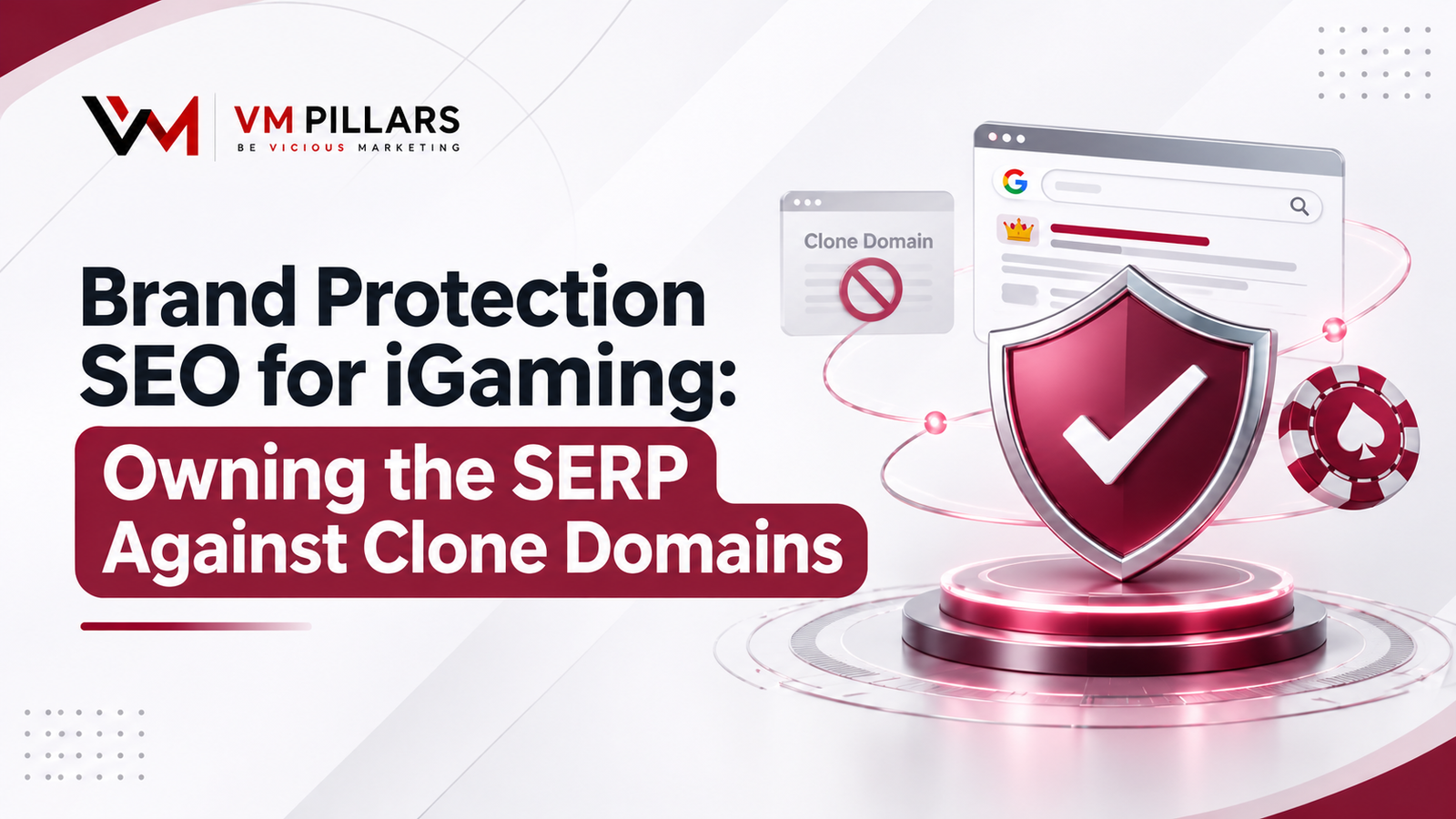
Search for your own casino brand right now. Look past the first result. In most regulated iGaming markets, somewhere on that first page you will find something you do not control. A clone site using your name with a different top-level domain. An affiliate page ranking above your own help center. A fake “official” mirror built to catch players mid-search and redirect the deposit somewhere else.
This is the part of iGaming SEO that operators notice last and pay for most. You can rank beautifully for your category terms and still lose players on the one query that should be the safest you own: your own brand name. Brand protection SEO is the discipline of making sure that when someone searches for you, every clickable result on that page works in your favor, not against it.
Why Clone Domains Target iGaming Specifically
Clone and mirror domains exist in every industry, but iGaming attracts them for structural reasons. Player intent is high and the deposit happens fast, so intercepting a branded search is immediately profitable. Many operators run mirror domains themselves to get around regional blocks, which trains players to expect several “official” looking addresses and makes a malicious clone harder to spot. And because paid brand defense is restricted in gambling, operators often cannot simply buy their way to the top of their own branded SERP the way a SaaS company would.
That combination means organic is your main line of defense. If you are not deliberately occupying your branded search results, someone else will occupy them for you. Clone operators understand that a branded search is a player who has already decided to play with you. They are not competing for demand, they are stealing a decision you already earned.
The Branded SERP Is a Surface You Have to Own Deliberately
Here is the mindset shift. Your branded search results are not a reflection of your brand, they are real estate. Every row on that first page is a slot that will be filled by something, and if you do not fill it, the market will. Clone domains, scraper sites, old affiliate pages, and outdated directory listings all compete for the space you leave empty.
Owning that surface means consciously ranking your own properties across the whole first page. Your main domain, your licensing and responsible gambling pages, your help center, your app listings, your verified social profiles, and your legitimate review presence. The more of those results you occupy with assets you control, the fewer slots remain for anyone impersonating you.
This is the same visibility problem that connects search, app store presence, and reputation into one job rather than three. The argument for why these cannot be managed in separate silos is laid out well in SEO, ASO and ORM are one visibility problem, and brand protection is where that overlap becomes most obvious.
How Clone Domains Actually Steal Your Rankings
Clone domains do not usually outrank your main site for your exact brand name. What they do is subtler and more damaging. They rank for the variations.
Players rarely type your brand perfectly. They add words. “Brand name login,” “brand name app download,” “brand name withdrawal,” “brand name bonus code,” “is brand name legit.” Each of those is a separate query with its own search results, and most operators never build dedicated pages for them. That gap is exactly where clones and scrapers live. They publish thin pages targeting “brand name login” and catch the player at the most sensitive possible moment, right as they are trying to access their account.
The leak is not on your core brand term. It is spread across dozens of branded long-tail variations you never claimed. Understanding how visibility quietly drains through the gaps in a results page is the same mechanic described in what SERP leakage is and why it costs regulated brands, applied here to your own brand name instead of your category.
Building a Brand Protection SEO System
Brand protection is not a one-time cleanup. It is a standing system with a few core parts.
Start by mapping every branded query that carries risk. Pull your branded search data, then expand it with the obvious intent modifiers: login, app, download, bonus, withdrawal, review, legit, alternative, and the common misspellings of your name. This is your brand protection keyword map, and most of these queries will surprise you with how much volume they carry.
Next, build or strengthen a dedicated page for each high-risk branded query so that your own result is the strongest, most obvious answer. A real login page, a real app page, a real withdrawals explainer. These are not marketing pages, they are defensive pages, and they exist so that no clone can rank for that intent unopposed.
Then occupy the rest of the first page with controlled assets. Verified social profiles, a legitimate presence on trusted review platforms, your licensing authority listing, and schema markup that reinforces your official identity. The goal is a first page where every single clickable result leads back to you.
Finally, monitor continuously. New clone domains appear constantly, so brand protection without ongoing monitoring decays within months. This defensive layer is a core part of structured SEO, ASO and ORM services, where branded search defense is treated as an ongoing operation rather than a single audit.
The AI Search Dimension Operators Miss
Brand protection used to stop at the Google results page. It does not anymore. When a player asks an AI assistant whether your brand is trustworthy, or which casino is best for a given game, the model answers from whatever it has absorbed about you across the open web. If clone domains, scam complaints, and impersonation pages dominate what AI systems have read, that is the brand narrative they will repeat, confidently and at scale.
This means brand protection now includes shaping what AI engines understand about your legitimacy. Clear, consistent, authoritative signals about who you are, where you are licensed, and how players reach you officially do double duty. They defend your traditional SERP and they inform the answer an AI gives when a player asks about you directly. The practice of auditing and correcting that machine-read narrative is covered in AI perception audits, and for iGaming brands it is quickly becoming inseparable from classic brand protection.
For operators who want this handled as part of a broader ranking and trust strategy rather than a standalone project, it sits naturally within dedicated iGaming SEO work, where owning the branded SERP and building category authority are run as one program.
5 FAQs
What is brand protection SEO in iGaming?
It is the practice of deliberately ranking your own trusted properties across your entire branded search results page so that clone domains, scrapers, and impersonators cannot occupy that space. For gambling brands, where paid brand defense is often restricted, organic ownership of your branded SERP is the main way to stop players being intercepted on searches for your own name.
How do clone domains hurt a casino brand?
They rarely outrank your exact brand name. Instead they target branded variations like “brand login” or “brand app download,” catch players at a sensitive moment, and redirect deposits, steal credentials, or damage trust. The financial harm comes from intercepting players who had already chosen you, so every lost click is a lost depositor you paid nothing to acquire and still lost.
Can I just report clone domains and have them removed?
Takedowns help but do not solve the problem. Reporting to registrars, hosts, and Google is worth doing, yet new clones reappear faster than old ones are removed. Takedowns are reactive. The durable fix is ranking your own assets so thoroughly that clones have nowhere to surface, combined with continuous monitoring to catch new ones early.
Which branded queries are most at risk?
The high-intent account and transaction queries: login, app download, withdrawal, deposit, bonus code, and “is brand legit” style trust checks. These carry real volume and are exactly the moments a player is most vulnerable to landing on a fake page. Most operators never build dedicated pages for them, which is precisely why clones rank there.
Does brand protection affect how AI assistants describe my brand?
Yes. AI engines form their answer about your trustworthiness from what they have read across the web. If impersonation pages and scam complaints dominate that picture, AI assistants may repeat it when players ask about you. Strong, consistent official signals protect both your traditional search results and the narrative AI systems generate about your legitimacy.