
The digital landscape shifted. AI answer engines change everything. Your traditional SEO content strategy, built for clicks, is now a liability. It generates traffic, yes, but often fails to convert. This is not sustainable. We must adapt, or your content budget becomes a donation to the internet’s data archives.
The goal is no longer just ranking. It is conversion. It is effective AI citation. It is driving measurable ROI. Your content must work harder, smarter, and with purpose.
The Flaw of “Informational” Bloat
For years, the mandate was clear: create high-volume, informational content. Rank for keywords. Drive organic traffic. This strategy worked, but often produced content rich in answers, poor in sales. AI amplifies this problem. AI scrapes answers directly. Your well-researched article might provide the answer, but the user never visits your site. This creates a dangerous conversion gap. We need content that compels action, not just passive consumption.
From Ranking to Revenue: The New Metrics
Ranking is a vanity metric. Conversions, qualified leads, and direct ROI are the true indicators of content success. AI functions as an answer engine. It condenses information. Your content’s value is now tied to its ability to be cited, to influence the “dark funnel” of pre-purchase research, and to directly facilitate a sale. Success means more than traffic. It means AI citation, measurable brand influence, and closed deals.
Content-to-Pipeline Mapping: Precision Engineering for Conversions
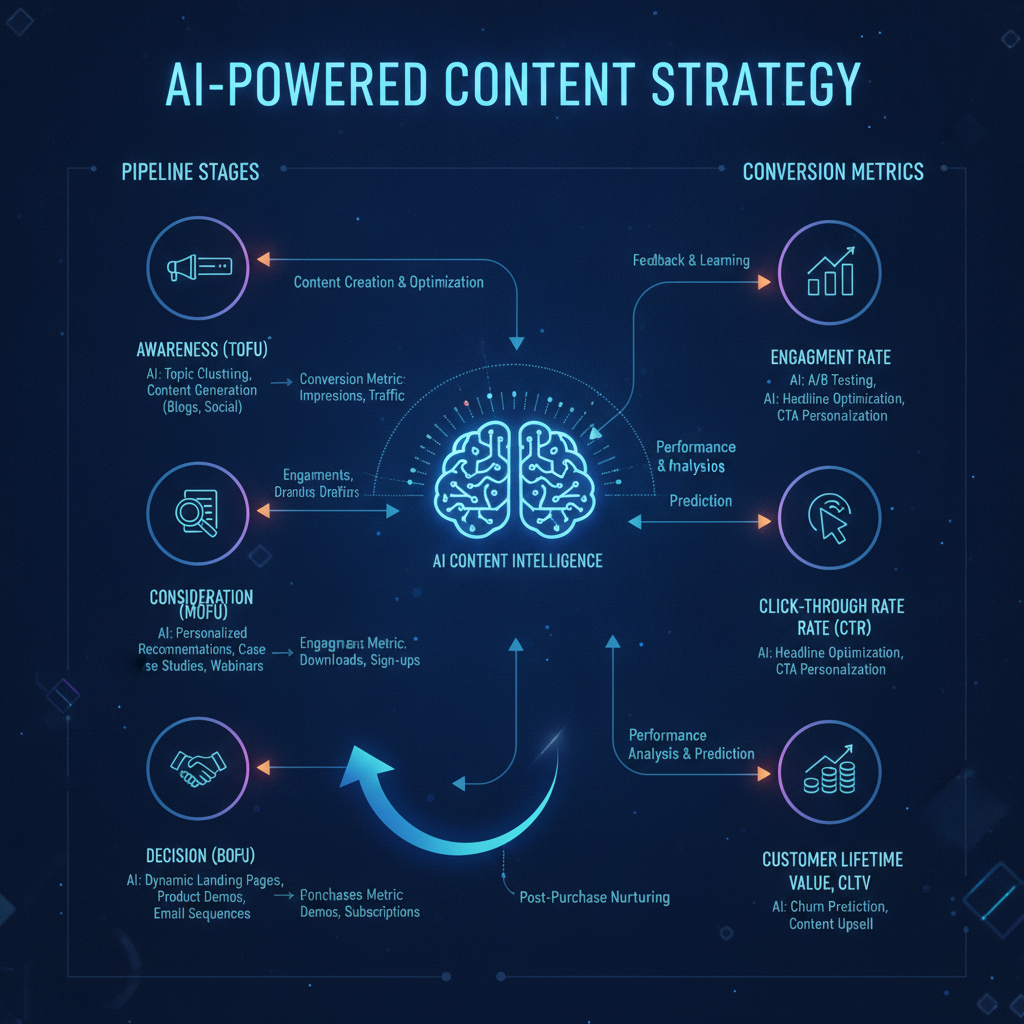
Every piece of content must serve a precise function within your buyer’s journey. This is not about guessing. This is about strategic alignment. Your content becomes a sales tool, guiding prospects through the pipeline with surgical precision.
Awareness Stage: Attracting the Right AI Attention
- Focus: Problem identification, high-level solutions. Attract attention from searchers, and more importantly, from AI.
- Content Type: Foundational articles, industry insights, comparative overviews.
- AI Optimization: Concise definitions, clear problem statements, benefit-oriented language. Emphasize original research, proprietary data. This positions you as a primary source.
- Goal: Establish authority, earn AI citation for key concepts.
Consideration Stage: Proving Value, Building Trust
- Focus: Solution exploration, detailed analysis, differentiation.
- Content Type: Case studies, “how-to” guides, detailed whitepapers, integration proofs, comparison charts.
- AI Optimization: Quantifiable results, specific methodologies, testimonials. Show, do not just tell. Demonstrate expertise with data and real-world examples.
- Goal: Educate, build trust, demonstrate unique capabilities.
Decision Stage: Closing the Loop with Authority
- Focus: Vendor selection, direct value proposition, ROI justification.
- Content Type: ROI calculators, competitive comparisons, implementation guides, pricing breakdowns, demo requests.
- AI Optimization: Direct answers to purchase-related questions. Clear calls to action. Highlight unique advantages, guarantee outcomes.
- Goal: Remove final objections, drive direct conversions.
Optimizing for AI Extraction and Citation
AI demands clarity and structure. Your content must be easily digestible for machine learning models. This is non-negotiable.
Structured Data and Semantic Clarity
Use schema markup where appropriate. Employ clear, hierarchical headings. Write short, punchy paragraphs. AI extracts data points, not flowery prose. Semantic clarity ensures accurate interpretation. Every sentence should deliver a distinct piece of information.
Original Data, Proprietary Research, and Integration Proofs
This is your ultimate differentiator. AI prioritizes unique, verifiable information. Your own market research, internal data, client success stories, and specific integration examples become invaluable. These establish you as a primary authority, a source worth citing. This is how you win in an AI-driven search world.
Traditional vs. AI-Optimized Content Strategy
| Feature | Traditional SEO Content | AI-Optimized Content |
|---|---|---|
| Primary Goal | Rank for keywords, drive organic traffic | Drive conversions, achieve AI citation |
| Success Metric | Page views, keyword rankings, time on page | AI citations, brand mentions, MQLs, SQLs, ROI |
| Content Focus | Broad informational, high volume | Pipeline-aligned, specific, conversion-focused |
| Structure | Often long-form, keyword-stuffed | Concise, semantically clear, structured for AI |
| Authority Source | Backlinks, domain authority | Original data, proprietary research, brand trust |
| AI Interaction | Limited direct citation | Designed for direct AI extraction and citation |
| Buyer Journey | Often generic, ignores pipeline stages | Explicitly mapped to buyer pipeline stages |
Beyond the Blog: Search Everywhere Optimization
Search is no longer confined to Google. It extends to social platforms, industry forums, voice assistants, and in-app functions. Your content must have a presence across all relevant channels. This is about building a holistic, ubiquitous digital footprint. It ensures your brand is discoverable, regardless of where the search originates.
The Power of Off-Page Authority
Brand mentions and high-quality backlinks remain critical. These signals inform AI about your credibility and relevance. A strong off-page profile reinforces your primary source status. Cultivate your reputation online and offline; it directly impacts your content’s visibility and citation potential.
Bottom Line
The era of generic, informational content for traffic alone is over. AI demands precision. Your content strategy must evolve from a ranking obsession to a relentless focus on conversion, measurable ROI, and strategic AI citation. Map your content to the buyer pipeline. Create unique, verifiable insights. Structure your content for AI ingestion. Adapt now, or your content marketing efforts will simply become overhead. The market waits for no one.
Frequently Asked Questions
How has AI impacted traditional SEO content strategy?
AI answer engines directly provide information, leading to a conversion gap where users get answers without visiting the website, rendering traditional click-focused strategies less effective for conversions.
What should be the primary goal of content in an AI-driven search environment?
The primary goal for content in an AI-driven environment should shift from solely ranking for keywords to driving conversions, achieving effective AI citation, and generating measurable ROI.
What is content-to-pipeline mapping in AI-optimized content?
Content-to-pipeline mapping is a strategic approach where every piece of content serves a precise function within the buyer’s journey, guiding prospects towards conversion through content types tailored for Awareness, Consideration, and Decision stages.
How can content be optimized for AI extraction and citation?
Content should be optimized using structured data, clear hierarchical headings, short paragraphs, semantic clarity, and by incorporating original data, proprietary research, or unique integration proofs to establish authority.
Why is original data and proprietary research important for AI-optimized content?
Original data, proprietary research, and client success stories are critical because AI prioritizes unique, verifiable information, establishing the content creator as a primary authority and a source worth citing.