
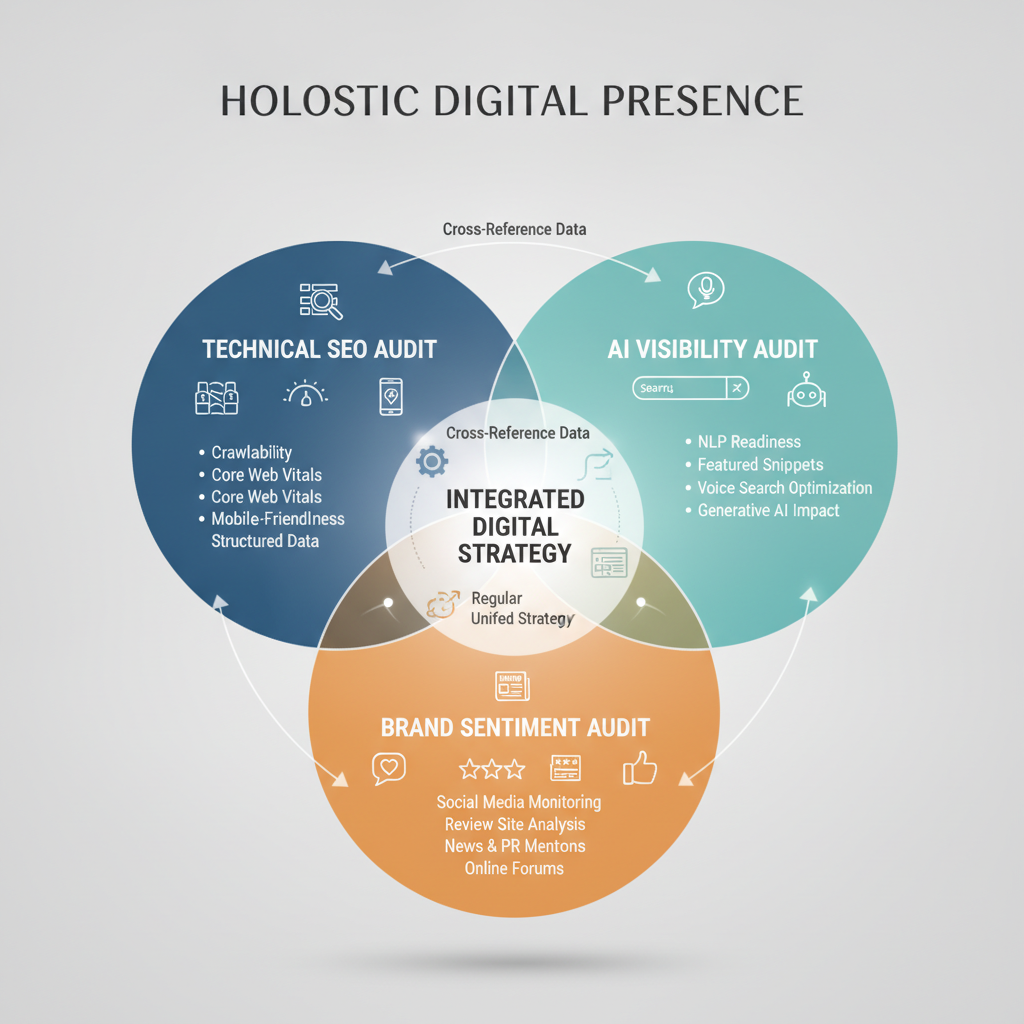
Traditional SEO audits are still essential, but they are no longer sufficient on their own. As search expands beyond conventional search results into AI-generated answers and conversational discovery, an effective audit needs to evaluate more than crawlability, indexability, and keyword targeting. It should also consider how clearly AI systems can interpret your content, how consistently your brand is represented across online sources, and whether your technical foundation supports machine-readable information.
We, as Vicious Marketing, focus on measurable impact. Your website must perform, not just exist. This guide details a comprehensive audit, integrating technical SEO with AI search presence and sentiment analysis. Prepare for an ROI-driven approach.
Each platform demands a nuanced approach. Optimize for where your audience seeks information.
The New Audit Imperative: AI’s Grip on Search
Google’s SGE, Perplexity, ChatGPT, Gemini. These are your new search engines. Your strategy must adapt. Traditional crawlability is foundational, not sufficient. You need AI comprehension.Beyond Crawlability, Towards Comprehension
- Search has evolved from keyword matching to understanding intent.
- AI models interpret content, not just index it.
- Your site’s technical health dictates AI’s ability to process and represent your brand.
The AI-First Search Landscape
AI models synthesize information. They answer questions directly. If your content is not structured, clear, and authoritative, AI will bypass it. This impacts your visibility, your traffic, and your bottom line.Phase 1: Technical Foundation, Built for AI
Before AI can trust your content, your website must be technically sound. This is non-negotiable.Core Technical Health: The Unsexy Essentials
- Crawlability and Indexability: Ensure AI bots can find and process every critical page. Use
robots.txteffectively, but considerLLMs.txt. - Site Speed and Core Web Vitals: Slow sites kill conversions. AI also penalizes poor user experience. Measure, optimize.
- Mobile Responsiveness: Mobile-first indexing is old news. Mobile-first experience is critical for human and AI interaction.
- Security (HTTPS): Trust is paramount. Encrypted connections are a baseline requirement.
Schema Markup for AI Understanding
Schema.org markup is your direct line to AI. It explicitly tells AI what your content means. This is not optional. Implement specific schema types, e.g.,Organization, Product, FAQPage, Article.
- Use JSON-LD for ease of implementation and machine readability.
- Validate all schema with Google’s Rich Results Test.
- Prioritize high-value content for structured data implementation.
LLMs.txt: An Emerging, Experimental Proposal
LLMs.txt is an emerging proposal intended to provide AI systems with structured information about a website. Unlike robots.txt, which has an established role in crawler access control, LLMs.txt is not a universally adopted web standard and should not be treated as a guaranteed mechanism for controlling how AI models access or use website content.
Considerations for LLMs.txt (Emerging and Experimental):
- Document Important Content: Provide a concise overview of key pages or resources that may help AI systems understand your website.
- Keep Information Current: Update the file when important content, resources, or site structure changes.
- Do Not Rely on It for Access Control: Use established mechanisms such as
robots.txtand appropriate server-level controls where access restrictions are required. - Monitor AI Visibility Separately: Test how AI systems actually represent your brand and content rather than assuming
LLMs.txtguarantees visibility, access, or attribution.
Phase 2: AI Visibility and Brand Sentiment, The New Frontier
Beyond technical integrity, we analyze your brand’s presence within AI-generated content and public perception.Auditing AI Search Presence
How often does your brand appear in SGE answers? Perplexity summaries? ChatGPT responses? This requires direct interaction with these platforms.- Manually query AI models with relevant keywords and questions.
- Track brand mentions and accuracy of information presented.
- Identify opportunities for your content to become the authoritative source for AI.
Brand Sentiment: A Quantifiable Metric
What does the internet say about your brand? AI models reflect this sentiment. Understanding and influencing it is critical for long-term growth. Programmatic Sentiment Analysis (Python Example): Automate the collection of public sentiment data across various platforms. This script provides a baseline for evaluating brand perception.from transformers import pipeline
def analyze_sentiment(text):
sentiment_pipeline = pipeline("sentiment-analysis")
return sentiment_pipeline(text)
# Example usage:
# comments = [
# "This product is amazing and truly innovative!",
# "Customer service was terrible, very disappointed.",
# "The new feature is okay, nothing groundbreaking."
# ]
# for comment in comments:
# result = analyze_sentiment(comment)
# print(f"Text: '{comment}' -> Sentiment: {result}")
transformers library. Real-world implementation requires API keys and data scraping.
This approach allows for scalable, objective measurement of public opinion. Monitor shifts, identify crises, and capitalize on positive feedback.
Prompt Engineering for Brand Perception Audits
Use AI models to simulate public perception. Craft specific prompts to extract sentiment and brand association from large language models. Custom Prompts for ChatGPT/Gemini:- “Act as a consumer who has recently interacted with [Your Brand]. Describe your overall experience and perception of the brand’s [product/service quality, customer service, value].”
- “Analyze recent public discourse on [Your Brand]. Summarize the prevailing sentiment regarding [specific attribute, e.g., innovation, trustworthiness, market position]. Provide examples.”
- “If [Your Brand] were a person, what three adjectives would describe them based on publicly available information? Justify your choices.”
Phase 3: Automation and Continuous Optimization
Efficiency scales through automation. Manual audits are insufficient for the speed of AI evolution.Programmatic Auditing: The Path to Scale
Integrate tools and scripts for continuous monitoring. Automate data collection for technical health, sentiment analysis, and AI visibility metrics. This provides real-time insights, allowing agile adjustments.- Use APIs for SEO tools, social media platforms, and AI models.
- Build dashboards to visualize performance trends over time.
- Set up alerts for significant shifts in sentiment or AI visibility.
Model-Specific Optimization Strategies
Different AI models operate differently. A blanket approach is naive. Tailor your optimization efforts.| AI Model/Platform | Optimization Strategy | Key Focus |
|---|---|---|
| Google SGE | Comprehensive, authoritative content. Strong E-E-A-T signals. Intent-based query targeting. | Direct answers, rich snippets, contextual relevance. |
| ChatGPT/Gemini | Clear, concise, factual content. Well-structured data for easy parsing. Prompt-friendly information. | Source attribution, factual recall, conversational relevance. |
| Perplexity AI | Deep dives, well-cited sources. Content that answers complex questions thoroughly. | Citation quality, comprehensive answers, factual depth. |
| Bing Chat/Copilot | Similar to Google SGE, but with emphasis on Microsoft’s ecosystem integration. | Concise answers, linked sources, product integration. |
Each platform demands a nuanced approach. Optimize for where your audience seeks information.