
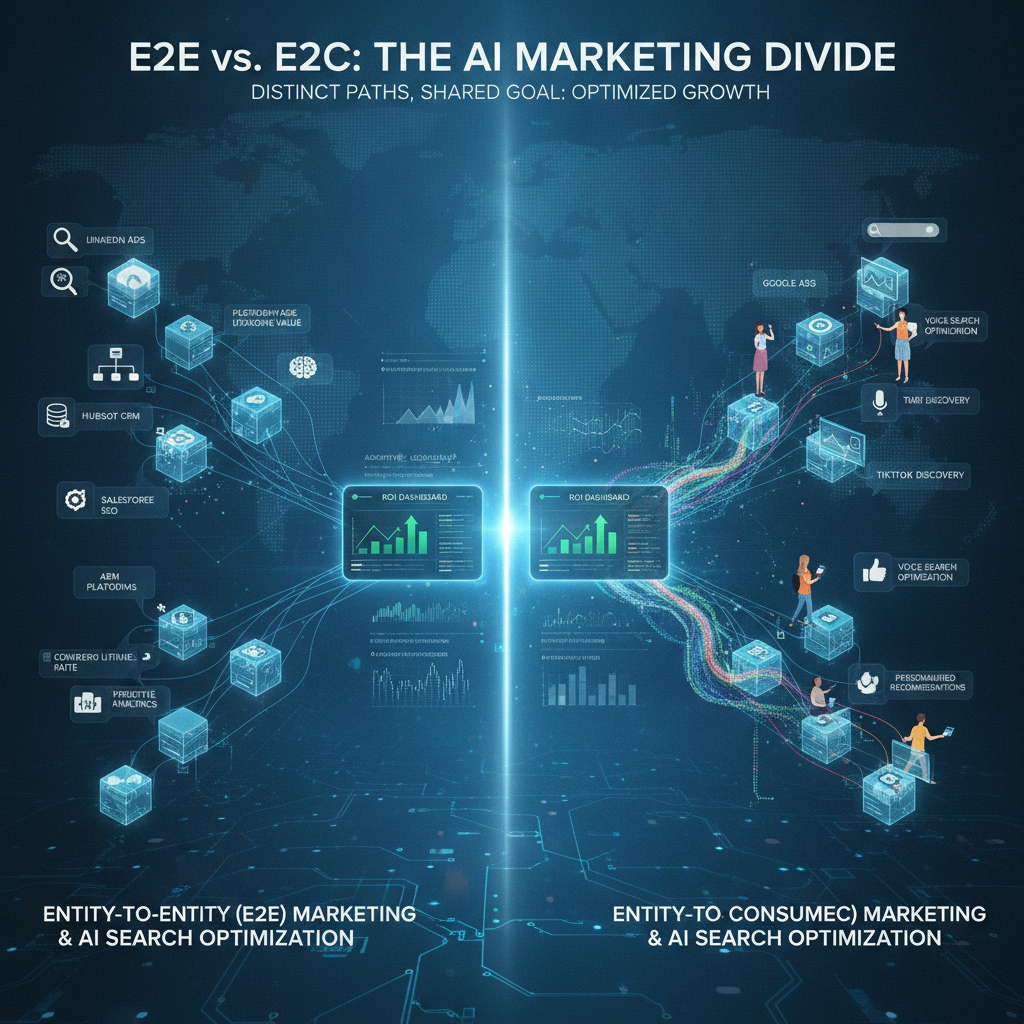
Businesses operate in two distinct arenas. They sell to other businesses, Entity-to-Entity (E2E). Or they sell directly to consumers, Entity-to-Consumer (E2C). These are not minor distinctions. They demand entirely different marketing strategies. Especially with generative AI now dictating search visibility.
The Fundamental Divide: E2E vs. E2C
Ignore the jargon. Focus on the mechanics. E2E transactions involve organizations. Think software licenses, industrial equipment, consulting services. E2C transactions involve individuals. Think consumer goods, subscription services, entertainment.
Audience, Sales, and Decisions: The Core Differences
- Target Audience: E2E targets committees, procurement teams, department heads. Rational actors. E2C targets individual desires, emotions, immediate needs.
- Sales Cycle: E2E sales cycles are long. Complex. Multiple touchpoints. High-value deals. E2C sales cycles are short. Often impulsive. Lower individual transaction value, high volume.
- Decision Drivers: E2E decisions are driven by ROI, efficiency, risk mitigation, long-term partnership. E2C decisions are driven by convenience, price, brand appeal, social proof, instant gratification.
An E2E buyer needs a solution to a systemic problem. They scrutinize specifications. An E2C buyer wants satisfaction. They respond to immediate prompts.
Marketing Strategies: Two Worlds Apart
Your approach must reflect these realities. Generic tactics fail.
E2E: Precision and Partnership
E2E marketing is about building trust. Demonstrating expertise. Proving ROI. It’s not about flash. It’s about substance. Content must educate, validate, and convert a skeptical, informed audience.
- Content Focus: Whitepapers, case studies, detailed implementation guides, webinars, industry reports, data sheets, expert opinion articles. These build credibility. They answer complex questions.
- Channels: LinkedIn, industry-specific forums, direct sales outreach, trade shows, targeted email campaigns.
- Metrics: Lead quality, sales qualified leads (SQLs), pipeline velocity, customer lifetime value (CLTV).
Success here demands deep market understanding. It demands a solution, not just a product.
E2C: Volume and Velocity
E2C marketing thrives on reach. Emotion. Urgency. It’s about capturing attention. Driving quick conversions. Content must be digestible, engaging, and directly address a perceived need or desire.
- Content Focus: Product reviews, user-generated content, how-to guides, short video ads, social media campaigns, promotional offers, FAQs. These build desire. They simplify decisions.
- Channels: Social media platforms, search engine marketing (SEM), display advertising, influencer marketing, email marketing for promotions.
- Metrics: Website traffic, conversion rate, cost per acquisition (CPA), average order value (AOV), social engagement.
Success here means understanding psychology. It means instant connection.
AI’s Transformative Impact on Search Optimization
Generative AI has fundamentally reshaped search. It moves beyond keyword matching. It understands intent. It synthesizes answers. This changes everything for E2E and E2C visibility.
E2E AI Search Optimization: Consideration Architecture
For E2E, AI is about building a “consideration architecture.” Your content must provide comprehensive, authoritative answers to complex inquiries. It must establish your entity as the definitive source. AI rewards depth. It rewards factual accuracy. It values problem-solving expertise.
- AI Forecasting: Generative AI accelerates E2E cycles by predicting buyer needs. It identifies emerging pain points. Your content must anticipate these. Provide the answers before they’re explicitly asked.
- Optimization Goals: Achieve high topical authority. Dominate answer boxes and featured snippets for specific industry challenges. Appear as a trusted source in AI-generated summaries for complex research queries.
- Actions:
- Create exhaustive guides addressing industry problems.
- Publish original research, data, and insights.
- Structure content for AI comprehension, using clear headings, definitions, and summaries.
- Link to reputable external sources, proving factual basis.
- Emphasize specifications, use cases, and quantifiable benefits.
Trust is paramount. AI evaluates trustworthiness. Your content must reflect it.
E2C AI Search Optimization: Transactional Discovery
For E2C, AI drives “transactional discovery.” Consumers ask direct questions. They seek immediate solutions. AI aims to provide the most relevant, concise, and actionable answer. Speed and relevance are critical.
- AI Prompting: AI guides E2C cycles by responding to specific prompts. It understands intent like “best running shoes” or “how to fix a leaky faucet.” Your content must directly address these prompts.
- Optimization Goals: Rank for direct, transactional queries. Appear prominently in quick answers, product comparisons, and localized results. Be the immediate, convenient solution.
- Actions:
- Optimize product pages with rich, detailed descriptions and high-quality images.
- Integrate customer reviews and FAQs directly into relevant pages.
- Create content that answers specific “how-to” or “best of” questions concisely.
- Ensure mobile-first design and lightning-fast page load times.
- Use structured data markup to help AI understand product attributes and pricing.
Immediacy is key. AI prioritizes direct answers for consumers.
Comparative View: E2E vs. E2C in the AI Era
Here’s a breakdown of the strategic differences that impact your bottom line.
| Feature | Entity-to-Entity (E2E) | Entity-to-Consumer (E2C) |
|---|---|---|
| Target Audience | Organizations, multi-person committees | Individual consumers, households |
| Sales Cycle | Long, complex, high-touch | Short, often impulsive, low-touch |
| Decision Drivers | ROI, efficiency, risk, partnership, data | Emotion, convenience, price, brand, immediate need |
| Primary AI Strategy | Consideration Architecture | Transactional Discovery |
| Content Focus | Authority, education, deep insights, specifications | Engagement, immediate answers, reviews, promotions |
| Profitability | Higher margin per transaction, fewer clients | Lower margin per transaction, high volume |
| Market Size | Niche, specialized; often global but targeted | Broad, mass market; often geographically focused |
The Critical Role of Trust and Immediacy
AI search amplifies these traditional marketing tenets.
- Trust: For E2E, trust is built through verifiable facts, transparent processes, and consistent thought leadership. AI identifies and rewards authoritative sources. Your content must be unimpeachable.
- Immediacy: For E2C, immediacy means providing the answer, the product, or the solution *now*. AI prioritizes content that directly satisfies urgent consumer queries. Optimize for speed, clarity, and directness.
Bottom Line
The E2E and E2C landscapes are fundamentally different. AI has not blurred these lines. It has sharpened them. Your marketing strategy, particularly your AI search optimization, must reflect these core distinctions. Adopt Consideration Architecture for E2E. Embrace Transactional Discovery for E2C. Ignore this at your peril. Your competitors are already adapting. Secure your market share. Drive measurable ROI. This is not optional. It is essential.
Frequently Asked Questions
What is the fundamental difference between E2E and E2C business models?
E2E (Entity-to-Entity) involves businesses selling to other organizations, characterized by long sales cycles and rational decisions based on ROI. E2C (Entity-to-Consumer) involves businesses selling directly to individuals, with short sales cycles driven by emotion and immediate needs.
How do marketing strategies differ for E2E and E2C businesses?
E2E marketing focuses on building trust and demonstrating expertise through educational content like whitepapers and case studies. E2C marketing prioritizes reach, emotion, and urgency using engaging content like product reviews and social media campaigns to drive quick conversions.
How has generative AI changed search optimization for E2E businesses?
For E2E businesses, generative AI drives ‘Consideration Architecture,’ rewarding comprehensive, authoritative content that anticipates complex buyer needs and establishes the entity as a definitive source for industry challenges.
What is the impact of generative AI on search optimization for E2C businesses?
For E2C businesses, generative AI facilitates ‘Transactional Discovery,’ prioritizing relevant, concise, and actionable answers that directly satisfy immediate consumer queries, such as product comparisons or ‘how-to’ questions.
What types of content are most effective for E2E marketing in the AI era?
Effective E2E content includes whitepapers, case studies, detailed implementation guides, original research, and data sheets, all structured for AI comprehension to build credibility and address complex industry problems.